
Uncategorized
https://www.themarysue.com/hotworx-woman-iowa/

A woman says she faced an unsettling encounter at her local Hotworx sauna when a man allegedly barged into her private workout session and demanded that she leave before her reserved time was up. What he did not expect, however, was that she would film the incident, post it to TikTok, and receive over 16.1 million views in the process.
In the viral clip, TikTok user Eliza Carlson (@elizacarlsonn) described how a man interrupted her scheduled sauna session on Aug. 5, claiming she needed to vacate the space because his session was booked for 7:30 p.m. Carlson had the room reserved until 7:30 p.m., meaning she still had seven minutes left when he entered.
A woman says she faced an unsettling encounter at her local Hotworx sauna when a man allegedly barged into her private workout session and demanded that she leave before her reserved time was up. What he did not expect, however, was that she would film the incident, post it to TikTok, and receive over 16.1 million views in the process.
In the viral clip, TikTok user Eliza Carlson (@elizacarlsonn) described how a man interrupted her scheduled sauna session on Aug. 5, claiming she needed to vacate the space because his session was booked for 7:30 p.m. Carlson had the room reserved until 7:30 p.m., meaning she still had seven minutes left when he entered.
Walter Mosley’s fiction has always carried a sting. His novels don’t just tell stories, they interrogate the world we live in. His 2004 book The Man in My Basement is no exception, and in Nadia Latif’s atmospheric adaptation, the sting has only sharpened. What emerges is less a conventional thriller and more a haunting psychological chamber piece anchored by two powerhouse performances: Willem Dafoe and Corey Hawkins.
Corey Hawkins plays Charles Blakely, a man caught in the quicksand of debt, grief, and disappointment. His mother has recently passed away, leaving him with both emotional wounds and the responsibility of maintaining the family home. Yet Charles, unemployed and drowning in bills, is on the brink of losing everything. Enter Anniston Bennet (Willem Dafoe), a stranger with a proposition: he’ll pay Charles an extraordinary sum of money in exchange for renting his basement.
At first glance, the deal seems like a lifeline. With Bennet’s money, Charles can save the house, buy himself time, and perhaps even find a path forward. But as Bennet settles into the basement, his eccentric requests and unnerving presence unsettle Charles. Soon, the arrangement begins to feel less like a rental agreement and more like a psychological trap.

Dafoe has built a career on walking the razor’s edge between charismatic and terrifying, and as Bennet, he’s at his most disquieting. His performance is deceptively quiet, there are no loud outbursts or violent rages here. Instead, he exerts power through silence, subtle shifts in tone, and that trademark stare that suggests he knows far more than he lets on. It’s a masterclass in controlled menace.
But while Dafoe provides the dread, Hawkins delivers the soul. His Charles is a portrait of quiet desperation, a man crushed not only by his circumstances but by the expectations and failures that shadow his life. Hawkins brings texture to the role—anger, shame, tenderness, and determination all flicker across his face. When Dafoe and Hawkins share the screen, it’s not just a meeting of characters; it’s a clash of worlds. Their dynamic carries the film, grounding its more abstract themes in something deeply human.
Latif, making her feature directorial debut, approaches Mosley’s text with both reverence and boldness. She’s not interested in conventional genre thrills. Instead, she crafts a slow burn that builds tension through atmosphere and implication. The Blakely home becomes both setting and symbol. Its walls echo with family history, while its basement transforms into a kind of moral underworld where hidden truths and buried fears can no longer be ignored.
The cinematography lingers on shadows and confined spaces, emphasizing the claustrophobia of Charles’s situation. Light often falls in stark, angular patterns, mirroring the film’s exploration of moral divides. The pacing may frustrate viewers expecting a traditional thriller, but Latif’s deliberate rhythm allows the tension to seep in gradually, almost imperceptibly, until it feels suffocating.

What sets The Man in My Basement apart is its willingness to wrestle with big, uncomfortable questions. At its heart, the film is about power — who has it, how it’s wielded, and the damage it inflicts. Bennet, with his wealth and privilege, can buy space in Charles’s home, but he cannot buy absolution for the sins he carries. Charles, meanwhile, is forced to confront not just Bennet’s intentions but his own agency, history, and the weight of systemic inequities that have shaped his life.
The story also speaks to the dangers of denial and forgetting. The basement isn’t just a literal space; it’s a metaphor for the things we bury. Trauma, injustice, shame and believing they’ll stay hidden. But as Latif makes clear, nothing buried stays gone forever. In that sense, the film resonates powerfully with contemporary conversations about race, history, and accountability.
The Man in My Basement is not a film that provides comfort. It doesn’t tie its narrative in neat bows or hand its characters easy resolutions. Instead, it leaves viewers unsettled, urging them to grapple with the questions it raises long after the credits roll. Some may find the pacing too meditative, the symbolism too heavy-handed. But for those willing to sit with its unease, the payoff is rewarding.
The film also serves as a reminder of the importance of representation behind the camera. Latif, a British-Sudanese director, brings a perspective that feels both personal and expansive, attuned to the nuances of race, power, and history in ways that enrich Mosley’s text rather than dilute it. Her collaboration with Hawkins and Dafoe results in a work that feels deeply contemporary, even as it wrestles with timeless themes.
At a time when Hollywood often prioritizes spectacle over substance, The Man in My Basement dares to slow down and dig deep. It asks difficult questions about morality, survival, and the weight of the past and it refuses to let us look away. Bolstered by extraordinary performances from Corey Hawkins and Willem Dafoe, and guided by Nadia Latif’s confident direction, the film stands as a bold and haunting adaptation.
For audiences who crave character-driven drama with teeth, this is not a film to watch casually it’s one to wrestle with. Because if The Man in My Basement teaches us anything, it’s that what we bury never truly stays gone.
The Man in My Basement premiered at the 2025 Toronto International Film Festival.
The post TIFF 2025 Review: Willem Dafoe and Corey Hawkins Face Off in ‘The Man in My Basement’ appeared first on Black Girl Nerds.
There can never be too many epic horror icons if you ask us. Freddie, Jason, Art the Clown, the list goes on—we know them AND we love each and every one. And what we love most is how no two horror icons are quite the same. Killer dolls—check! Killer clowns—check! Even killer phone apps have made their presence known. Horror icons have come in every shape and size because there are basically horror movies made about every topic under the sun. However, it turns out that one thing we haven’t had yet is a baseball horror movie and an iconic character to go along with it. And that seems like a real shame because America’s favorite pastime is rife with gorrific opportunities. The woosh of the bat into a face? The crash of a ball into a mouth? We can picture it. And now, director Ben Trandem and writer-producer John Ungaro want to bring that thought to life with their short baseball horror movie, Basher. But Basher won’t just be a movie; he’ll be your next great horror villain—IF you support him on Kickstarter. All you have to do is take one look at him to know it’s true.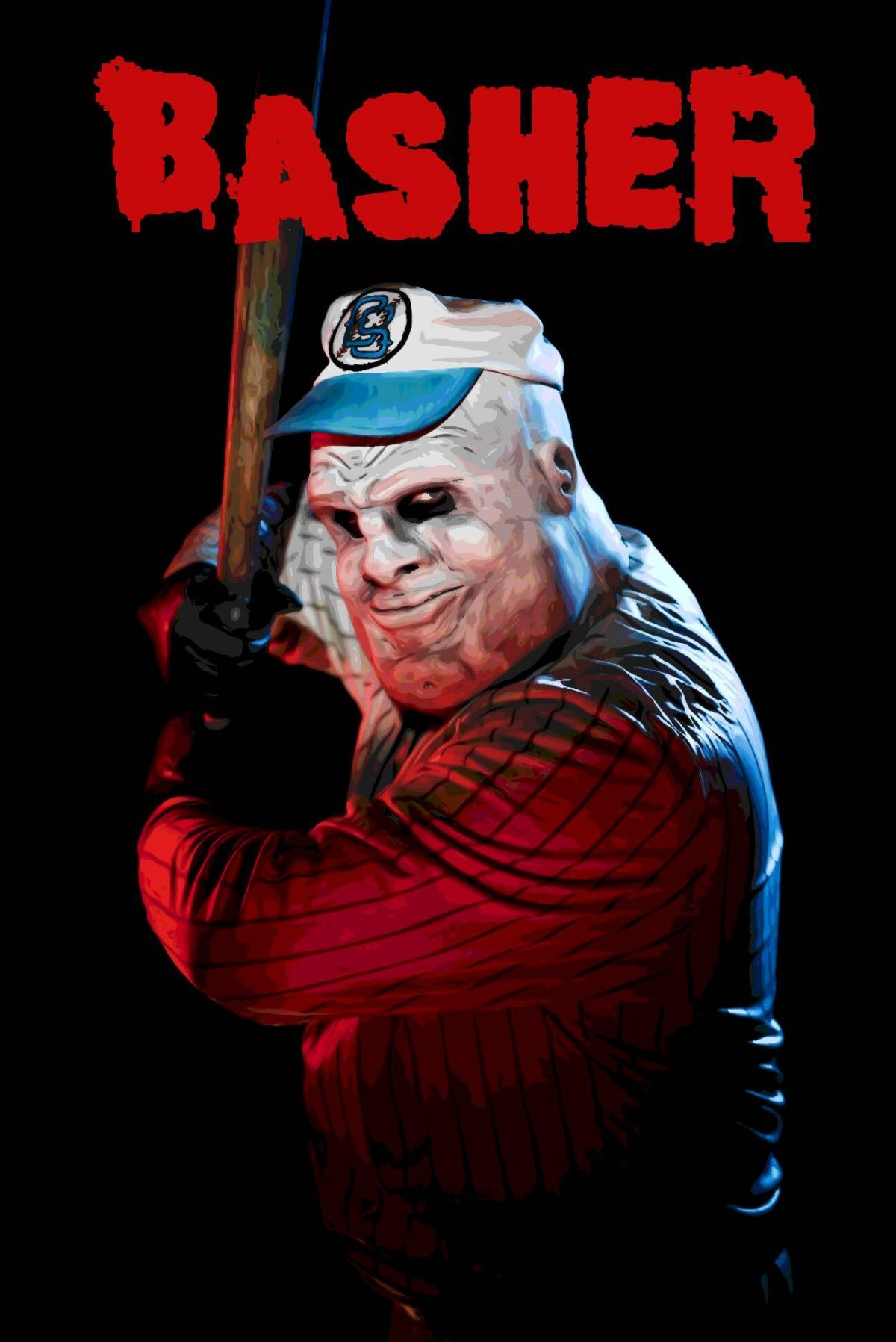
In a sentence, Basher is “A balls-to-the-wall slasher about a group of townies trying to survive the fury of a homicidal baseball mascot in their local dive bar.” Listen, if the words “homicidal baseball mascot” don’t sell you, you should take a good, long, hard look at yourself. In addition, the creators share that this short film is a “carnage candy thrill-ride” that is non-stop. Basher is not like any other horror icon out there that you might be imagining; he is a wrecking ball. He’s not sneaking or hiding; he is going straight through, but he’s also human to the core. It’s a powerful combo. And, I mean, just look at that mask.
It’s also kind of incredible that there has never been a baseball horror movie before. If you check out the first seconds from Basher that the team has put together for the Kickstarter, complete with a human ball mount and a bloody bat, you’ll see precisely why it’s a brilliant idea. Blood meet bat meet ball meet human flesh. We’re shivering and cackling all at once. And Basher’s whistling as he works really clinches it for us. It’s worth pointing out that untrodden horror ground is so rare, and that makes it all the more exciting to discover.
Basher‘s concept of “a decaying Americana” also really appeals. The description for the short film notes that it feels like “Nostalgia has had a long grip on culture, but there’s something off. It should be something warm, but it’s twisted and sinister.” As we mentioned, there’s something so quintessentially American and apple pie about baseball—it seems so harmless, in a way, compared to other sports—that it really begs to be twisted up into something falling apart and vicious. And Basher seems to have the perfect pulse on how to do it.
But Basher won’t get to become an icon without you. All of this horror goodness can’t come to fruition without a little help from the team. In order to cover the creation of Basher, the creators of the horror short have put together a Kickstarter. Your support will help Basher get made and pave the way toward the rise of a new horror icon. That’s a home run if you ask us. Support Basher today, and let’s hit this one out of the park.
The post Help Basher & His Bloody Baseball Bat Become Our Next Horror Movie Icons via Kickstarter appeared first on Nerdist.