Jasmine Stradford sat on her porch near Binghamton, New York, with toys, furniture, garbage bags full of clothing, and other possessions piled up around her. She and her partner were being evicted after falling behind on rent and pondered which option could help her family: shelters, hotels, or the street.
So last June, they and their children—then ages three, 12, and 15—turned to New York’s emergency shelter system for help. It was built to provide homeless residents not only beds, but also food, help finding permanent housing, and sometimes child care so parents can find work, attend school, or look for apartments.
Stradford and her family received almost none of that. Instead of placing them in a shelter, the Broome County Department of Social Services cycled them through four roadside hotels over three months, where they mostly had to fend for themselves.
“I remember staring at my kids, thinking that I’d failed them,” Stradford said. “Then I remember going to DSS and being completely dehumanized.”
Stradford’s family was part of a growing trend: In the past few years, hotels have quietly become the state’s predominant response to homelessness outside New York City, The Economic Hardship Reporting Project, New York Focus, and ProPublica found that the state’s social services agencies placed just under half the 34,000 individuals and families receiving emergency shelter outside the city in fiscal year 2024 in hotels—up from 29% in 2018. The change was most pronounced in Broome County, where hotel cases more than quintupled.
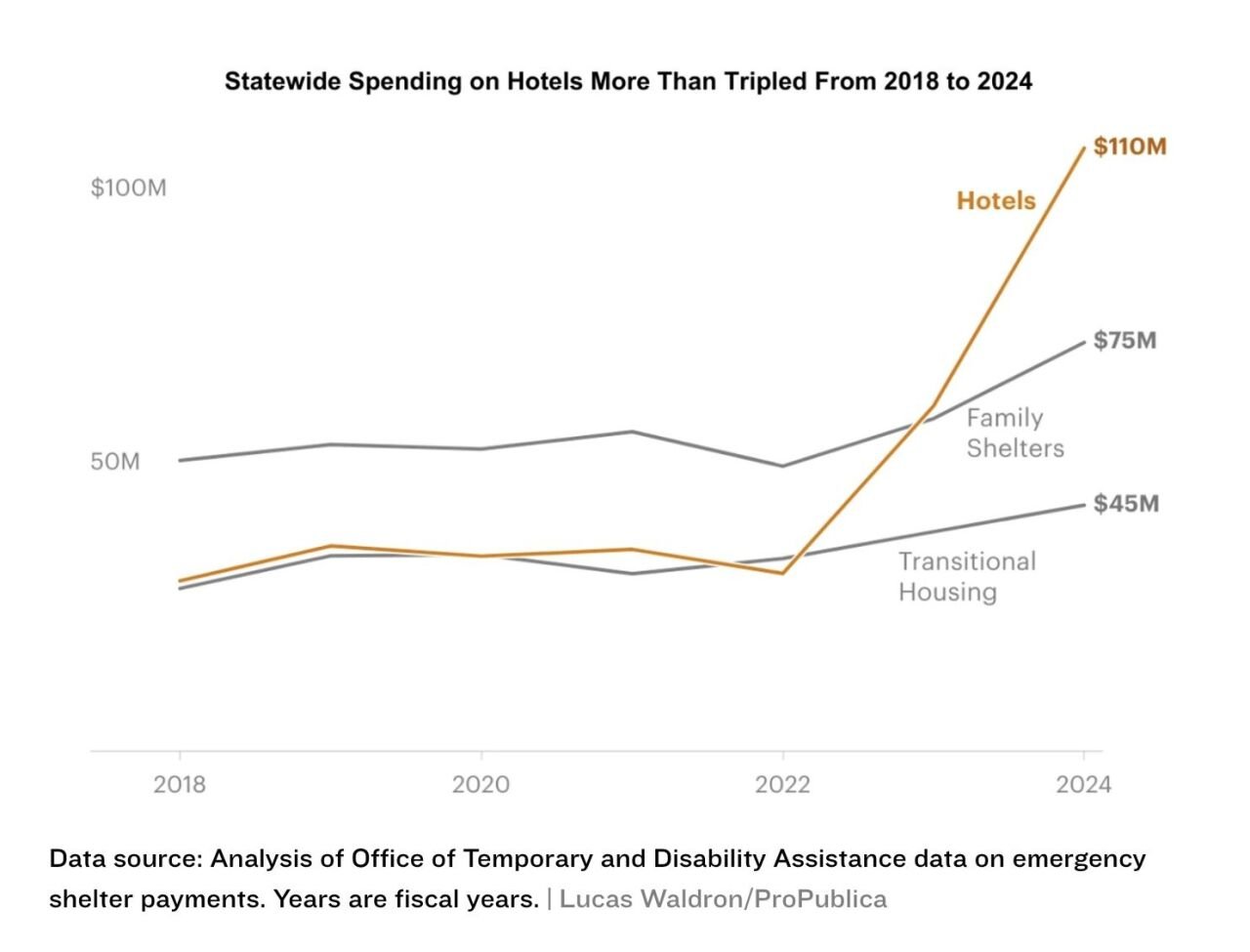
Statewide spending on hotels more than tripled over that period to $110 million, according to an analysis of state temporary housing data by the news organizations. In total, hotels outside New York City were paid about $420 million to shelter unhoused people from April 2017 to September 2024.
Lucas Waldron // ProPublica
It’s a makeshift arrangement that provides people with a roof over their head but little else. State regulations exempt hotels from providing the same services that families are supposed to receive in the shelter system.
The hotels are “less supportive, less conducive for good health outcomes, good education outcomes,” said Adam Bosch, CEO of Hudson Valley Pattern for Progress, a policy research nonprofit. “If our ultimate goal is to get people moving back toward independence, sticking them in a hotel on a hillside away from services, away from schools, away from transportation networks is not a great strategy.”
Homelessness in New York City received intense media coverage as the migrant crisis became fodder in the presidential election. But far less attention has been paid to the homeless population throughout the rest of New York, which far surpasses most other states on its own.
A few of the migrants were relocated to hotels outside the city. Instead, the spike in hotel housing stems from a combination of soaring rent, dozens of shelter closures, and what housing advocates and industry representatives said was a botched response to the end of the state’s pandemic-related eviction moratorium in 2022. After the moratorium ended, landlords began evicting tenants at rates exceeding previous years. With fewer shelters and more people in need, the number of individuals and families placed in hotels shot up.
Barbara Guinn, the commissioner of the state Office of Temporary and Disability Assistance, said in an interview that her agency hadn’t studied the growth in hotel use for emergency shelter. The trend has been scarcely mentioned at legislative hearings in Albany.
But OTDA, which supervises the county social services offices, has long known about the problems the hotels present. In early 2020, state auditors warned the agency that it wasn’t adequately overseeing shelters, including hotels used as temporary housing. OTDA acknowledged that hotels present challenges because they don’t have on-site support services or the same level of supervision as shelters.
Rules clarifying the requirement that temporary housing recipients in hotels receive shelter-like services have been on OTDA’s regulatory agenda for at least four years. But the agency, and lawmakers who oversee it, stood by as hotel housing increased. Guinn said she couldn’t “provide insight” on why the agency never formally proposed the rules, but she committed to advancing them this year. The Broome County Department of Social Services did not make its commissioner, Nancy Williams, available for an interview and did not respond to a detailed list of questions.
Reporting across the state, the news organizations found people living for months and sometimes years in hotels, doing what they can to get by. Families share beds while their belongings fill the corners of their rooms. Without kitchens and barred from using most appliances, they trek down shoulderless highways to grocery stores or scour food pantries for anything they can cook in a microwave. They squish cockroaches skittering in dressers. And hotels often force them to move out every few weeks, keeping stability out of reach.
The four hotels that Stradford’s family was placed in last summer collectively made about $10,000, sheltering it over three months — more than what the family owed in back rent. That works out to more than twice the monthly fair market rent for a four-bedroom apartment in Binghamton at the time.
This isn’t unusual. County social services offices regularly pay the hotel’s rates that are worth many times fair market rent for permanent housing in their areas, according to the analysis of OTDA’s housing payment data. One motel in Rome, outside Utica, that was the scene of a shooting last fall charged the county $250 a night for a room at times, according to invoices submitted to the county’s Department of Social Services.
Over three months, Stradford’s family struggled to maintain some semblance of its old life while bouncing from hotel to hotel. The family would lose countless possessions. The kids’ educations would be disrupted, as the school bus failed to keep up with their moves. Their experiences would show the importance of the services they weren’t receiving and what happens to New York’s homeless families when they can’t access them.
“It’s Like Malpractice”
Stradford and her partner, Tiberious Moses, had been evicted after she missed work at a children’s group home while recovering from surgery, and Moses struggled to support the family with temporary jobs. At first, Stradford was relieved when the Department of Social Services informed her that it would place them in a hotel instead of a shelter.
“Going to the hotel, I originally thought, ‘OK, this gives a little bit more leeway, a little bit more comfort, hospitality, all of that,’ only to find out that it’s not that at all,” she said. “If you are a DSS recipient, you’re nothing. You are the bottom of the pit.”
Stradford’s family—two adults, three children, and four dogs—was packed into a room with two beds at an Econo Lodge sandwiched between a gas station and another budget hotel. Stradford said she found cockroaches and had trouble getting the hotel to clean their room. She said she often saw drug use at the hotel and felt unsafe. Law enforcement and emergency services were called to the hotel 116 times in the first half of that year, dispatch logs show.
Despite those conditions, the Econo Lodge received more money to house temporary assistance recipients than any other known hotel outside New York City, according to the OTDA payments data for the 2024 fiscal year. The hotel, now called Hillside Inn & Suites, served more than 900 individuals and families placed by the Department of Social Services for at least 30,000 total nights, earning over $2.3 million.
“We’re forced to rent hotel rooms across the state, and the operators of these places understand that,” said state Sen. Roxanne Persaud, chair of the chamber’s Social Services Committee. “The municipalities’ backs are against the wall. And so they must place the unhoused person or persons somewhere. And so that’s why you see the cost is skyrocketing, because people understand that it’s an easy way to make money off the government.”
OTDA’s regulations say hotels should be considered shelters and provide services if they are used “primarily” as temporary housing for homeless welfare recipients. At least 16 hotels appear to house mostly welfare recipients, the analysis showed.
OTDA spokesperson Anthony Farmer said the agency interprets “primarily” to mean hotels that “house recipients exclusively, or almost exclusively, throughout the year.” He said that hotels aren’t required to deliver services but that county social services agencies “are responsible for some level of service provision.” The state, however, doesn’t regularly collect information on how counties provide services. Guinn said OTDA plans to create a formal process for counties to submit it under new regulations.
The Econo Lodge’s contract with Broome County doesn’t call for the services offered by shelters, like food and assistance finding housing. It requires the hotel to provide little more than a room with housekeeping, linens, and toiletries. The hotel’s CEO, Paresh Patel, declined to comment.
In contrast, traditional shelters often put a significant amount of their funding toward social services. Shelter budgets obtained from OTDA show that they frequently retain at least part-time employees to prepare food and help people find jobs and housing. Local social services offices try to offset the lack of on-site services by hiring caseworkers, but have struggled to retain them.
Instead, hotel residents like Stradford’s family are caught in a web of conflicts between the way those services are provided, the strings attached to benefits, and the rules and limitations of living in hotels. Social services departments might provide them with food stamps to buy groceries, but hotel residents usually don’t have kitchens and are often not allowed to have appliances like hot plates. To keep their lodging, they’re generally required to seek housing and to work or look for jobs, but they often don’t receive child care. They have to regularly meet with caseworkers at social services offices, but must rely on spotty public transportation.
“To me, it’s like malpractice as a homeless services provider to place people without support services” in hotels, said Deborah Padgett, a professor of social work at New York University. “It’s good in the sense that they get more privacy, but for them to get a life and not be dependent on the government, they need to be close to services and not be punished for making mistakes.”
Guinn said that her agency would prefer counties use regulated shelters in housing emergencies, but that there aren’t enough beds to accommodate everyone. Social services offices must rely on hotels when shelters don’t have space or don’t exist in a particular county, Farmer said in an email.
After 26 nights, Broome County relocated Stradford’s family to the Quality Inn & Suites in Vestal, a Binghamton suburb down the Susquehanna River that’s home to Binghamton University. Stradford’s car had been repossessed, so they stuffed a suitcase and the kids’ book bags with as many clothes as they could and hopped on the bus.
At the Quality Inn, the family struggled to eat. They had applied for food stamps, but Stradford said she couldn’t get wage records from her former employer proving she was eligible. Instead, the county provided them a restaurant allowance worth about $15 a day to cover all five of them. To get by, they took the bus to food pantries like Catholic Charities, which had started creating “hotel bags” stuffed with canned food, oatmeal, crackers, macaroni, and cheese and snacks for the kids—anything that could be eaten cold or prepared with a microwave.
While many shelters provide food on site, contracts between the hotels and Broome County forbid emergency housing recipients from eating the hotels’ food. Stradford said her family was threatened with removal from the Quality Inn after her 12-year-old daughter, Taylor, tried to eat the continental breakfast.
“When we first started taking families on, we did allow breakfast, and unfortunately, there was too much being carried away, so we chose to change that,” the hotel’s general manager, Bernadine Morris, said. The Quality Inn has since closed and could not be reached for follow-up questions.
People can get kicked out of hotels and lose their housing assistance for repeatedly violating hotels’ policies, including by using their own cooking appliances. One woman who previously lived at the Motel 6 in Binghamton said she avoided sanctions by throwing an extension cord from the window of her second-story room to use a pressure cooker on the sidewalk.
Stradford’s nonstop juggling act left her on edge. She was grieving her mother’s death, feeding five people and four dogs, apartment-hunting, and hustling to culinary classes and social services appointments. She said her children started feeling the stress too: Her three-year-old, Samir, was wetting the bed frequently, and the older kids missed classes for their summer courses.
The family began butting heads with Quality Inn managers, who accused them of being disruptive and terminated their stay, according to Stradford’s social services case file.
“I’m not totally surprised that they run into problems with the hotel supervisors and the staff just because they’re trying to find some way to get their needs attended to, and it’s not really fair to expect the hotel to do what those people are not trained to do,” Padgett said.
Shelters are required to have enough qualified staff to meet residents’ needs. The staff members generally have at least some training in how to handle populations with complex needs, said Elizabeth Bowen, an associate professor at the University at Buffalo School of Social Work.
After Stradford and her family lost their room at the Quality Inn, the county sanctioned them and declined to find them a new place to stay. Moses, who had just gotten a job at Dave & Buster’s, paid out of his own pocket for a room at the Red Roof Inn in Johnson City. When they arrived, the woman at the front desk saw their belongings and dogs and told them the motel wouldn’t honor the reservation. They had used what little money was left on Uber and the room deposit. The motel did not return requests for comment.
As it rained, Stradford got a hold of the Department of Social Services and pleaded their case. The county decided to continue housing her family until her sanction could be appealed. It booked them at the Knights Inn, another 10 minutes down the road in a town called Endwell.
“I Got Into Protection Mode”
Stradford’s family became skilled at sleeping on a single bed at the Knights Inn. Stradford, Moses, Samir, and 15-year-old De’Vante would sleep side by side while Taylor slept horizontally at their feet.
The rest of the facility was in chaos, Stradford said. She saw hypodermic needles and other drug paraphernalia lying in the grass and underneath the stairwell, and people slumped over while standing beside the dumpster. Over about six years that the county used it for temporary housing, law enforcement and emergency services were summoned to the motel for 789 incidents, including assaults, overdoses, robberies, domestic disputes, and mental health crises.
The Knights Inn had a litany of issues that prevented it from passing Broome County Social Services’ inspections from 2018 to 2021. According to inspection reports, the rooms were dimly lit due to missing light bulbs and broken lamps. The walls were stained and punched through, and the wallpaper peeled off. Some rooms’ doors didn’t lock. Windows didn’t work either or were broken. Carpets were torn, and inspectors found cockroaches in dressers.
Health and safety issues plague hotels used as emergency shelters across the state. A 2020 state comptroller audit found that 60% of the hotels they reviewed outside New York City were in “unsatisfactory” condition—about the same as the percentage of shelters.
One woman, who was living with her children in a motel south of Albany, showed paint flaking off their walls and mattresses covered in black mold. Two other parents placed in the motel said they felt that if the Department of Social Services caught them in private housing that resembled their living conditions, their kid could be taken away by Child Protective Services.
OTDA requires social services agencies to inspect hotels housing families every six months. But an analysis of OTDA compliance data showed that social services districts often fail to keep up with hotel inspections: About 40% of the 351 hotels used to house homeless people outside New York City were out of date on their social services inspections as of mid-October, or didn’t have an inspection date listed.
Farmer, the OTDA spokesperson, said that most hotels had been inspected within a year and that some others had stopped housing people.
Even when social services agencies do inspections, records show they sometimes fail to take action. Hotels have to correct problems within 30 days, unless it’s a safety problem. If they don’t, counties are supposed to stop placing people there, according to a directive from OTDA.
Records show that the Knights Inn fixed some of the issues as it went, but continued to get written up in every inspection for two and a half years. Despite this, Broome County placed hundreds of social services cases there, earning the motel over $750,000.
A Knights Inn manager, Aizaz Siddiqui, said that the motel moved people out of rooms that needed the most work until they were renovated.
In January 2021, the county said it would stop placing people at the Knights Inn until the violations were corrected. The motel received a clean inspection in July 2022. But Stradford said the Knights Inn wouldn’t give them toilet paper or fresh sheets, which are required in shelters. A bedsheet was used as a curtain for their rear window.
The family stayed for three weeks, but tensions with management boiled over when the family failed to get rid of their dogs by the deadline set by the motel. Eventually, the Knights Inn told them to leave. After giving them a few extra days to find other accommodations, Siddiqui called the police to remove them.
Siddiqui said the families placed at the inn by the Department of Social Services deserve sympathy, but he still has to maintain order. “It’s a tough situation to be in, and we try to work with them as much as we can,” he said. “But again, we do have to fulfill our policies, and we have to stand by them.” The motel declined to respond to additional questions about the conditions.
Stradford’s family didn’t have anywhere else to go. As the State Police arrived, she planted herself on a red cooler in front of their room and refused to leave until the county found them somewhere to stay.
Some community activists she met through local charity work showed up to support her and livestreamed the incident on Facebook.
After a three-hour standoff, management relented and allowed the family to stay two more nights. One of the activists arrived with a U-Haul and drove their stuff to the Motel 6, a 15-minute drive back up the river, past the Econo Lodge on the outskirts of Binghamton.
Things were initially calm at the Motel 6. But about three weeks into their stay, the Motel 6 complained to the county that Stradford had left the children alone, which they were told violated the motel’s guest policy. Stradford said she was doing charity work at the time, but complained that she couldn’t attend school or meet the state’s requirements to look for housing if she had to constantly supervise her children.
The motel gave the family the weekend to leave. When they missed their checkout time, the Sheriff’s Office came to remove them.
Moses called Stradford, who was at school, to tell her what was happening. She headed to the Department of Social Services to plead their case.
“I got into protection mode,” Stradford said. “I wasn’t going to leave there and just put myself in a seriously homeless situation. So I told them I wasn’t leaving until I knew that we had a secure spot to go to.”
But her attempts failed. The agency said it would no longer help her family due to the complaints. The clerk used a special tool to unlock the room for the deputies.
Community members once again showed up to livestream the encounter and pressure the county. The Sheriff’s Office helped the family find a motel, where it stayed for two more nights.
In the end, it wasn’t New York’s social services system that found stable housing for Stradford’s family; it was a local landlord who heard about the case and offered an apartment at a rate the family could afford on Moses’ wages and temporary assistance from the county.
Stradford’s family was placed in hotels for 89 days, about the average for a social services case. Many stay far longer. More than 1,500 individuals and families spent six months or more in hotels, according to payment data from the 2024 fiscal year.
“Some of us really get into a hard time, and we really do need the help. We don’t just rely on the system,” Stradford said. “I pay my hard-earned tax dollars. I worked multiple jobs. I’m the one that tried to keep afloat and stuff like that. But things happen in life.”
Between their six moves, the family lost most of its possessions: furniture, Social Security cards, birth certificates, tax documents, family photos, laptops, coats, a painting from someone Jasmine was taking care of, Samir’s toy box, Taylor’s art projects, and a blanket covered in motivational quotes that Stradford’s mom had given her before she passed. They had to give up two of their dogs.
When they arrived at their new home, they had only a couple of suitcases and garbage bags full of clothes.
How hotel stays were measured
To track temporary housing recipients placed in hotels, New York Focus and ProPublica used data obtained from the New York Office of Temporary and Disability Assistance through an open records request. The data contains 1.1 million payments issued from April 2017 to September 2024 for emergency shelter stays outside New York City. OTDA repeatedly delayed releasing the data for 10 months, but finally did so after ProPublica’s attorneys got involved in the appeals process.
The data classified payments by type of shelter, including family shelters, transitional housing, and hotels. It also included an “emergency shelter” category for temporary housing assistance provided before a case is fully approved, which can flow to both hotels and shelters.
This analysis includes only payments explicitly classified as hotel payments. Excluded were some payments that were classified as hotel payments but where the recipients appeared to be nonprofits that operated homeless shelters.
The data also included unique IDs for each assistance case that received shelter, allowing the reporters to determine how many people stayed in hotels and for about how long. Each case represents either an individual or a family.
To find hotels that housed mostly welfare recipients, New York Focus and ProPublica relied on each hotel’s total number of rooms reported to the New York State Department of Health and checked whether shelter payments covered at least half of the hotel’s total capacity from April 1, 2023, to March 31, 2024.
The data listed the start and end dates for each payment, but it was not always clear whether the stay was inclusive or exclusive of the final date. As a result, the final night was excluded when counting up dates to create the most conservative estimates possible, unless the payment covered a single night. When comparing the payments against fair market rent, they included the final night, which would decrease the daily rate.
Hotels used to house homeless families outside New York City must be inspected by counties once every six months. After that, the district has 30 days to submit the report to OTDA for review.
OTDA provided a database of inspections for hotels as of Oct. 15, 2024. To determine whether a hotel was past due on inspection, the reporters checked whether the most recent inspection was completed and submitted to OTDA in the seven months leading up to that date. In some cases, the inspection may have been conducted but was not submitted to the state on time.
Jasmine Stradford sat on her porch near Binghamton, New York, with toys, furniture, garbage bags full of clothing, and other possessions piled up around her. She and her partner were being evicted after falling behind on rent and pondered which option could help her family: shelters, hotels, or the street.
So last June, they and their children—then ages three, 12, and 15—turned to New York’s emergency shelter system for help. It was built to provide homeless residents not only beds, but also food, help finding permanent housing, and sometimes child care so parents can find work, attend school, or look for apartments.
Stradford and her family received almost none of that. Instead of placing them in a shelter, the Broome County Department of Social Services cycled them through four roadside hotels over three months, where they mostly had to fend for themselves.
“I remember staring at my kids, thinking that I’d failed them,” Stradford said. “Then I remember going to DSS and being completely dehumanized.”
Stradford’s family was part of a growing trend: In the past few years, hotels have quietly become the state’s predominant response to homelessness outside New York City, The Economic Hardship Reporting Project, New York Focus, and ProPublica found that the state’s social services agencies placed just under half the 34,000 individuals and families receiving emergency shelter outside the city in fiscal year 2024 in hotels—up from 29% in 2018. The change was most pronounced in Broome County, where hotel cases more than quintupled.
Statewide spending on hotels more than tripled over that period to $110 million, according to an analysis of state temporary housing data by the news organizations. In total, hotels outside New York City were paid about $420 million to shelter unhoused people from April 2017 to September 2024.
Lucas Waldron // ProPublica
It’s a makeshift arrangement that provides people with a roof over their head but little else. State regulations exempt hotels from providing the same services that families are supposed to receive in the shelter system.
The hotels are “less supportive, less conducive for good health outcomes, good education outcomes,” said Adam Bosch, CEO of Hudson Valley Pattern for Progress, a policy research nonprofit. “If our ultimate goal is to get people moving back toward independence, sticking them in a hotel on a hillside away from services, away from schools, away from transportation networks is not a great strategy.”
Homelessness in New York City received intense media coverage as the migrant crisis became fodder in the presidential election. But far less attention has been paid to the homeless population throughout the rest of New York, which far surpasses most other states on its own.
A few of the migrants were relocated to hotels outside the city. Instead, the spike in hotel housing stems from a combination of soaring rent, dozens of shelter closures, and what housing advocates and industry representatives said was a botched response to the end of the state’s pandemic-related eviction moratorium in 2022. After the moratorium ended, landlords began evicting tenants at rates exceeding previous years. With fewer shelters and more people in need, the number of individuals and families placed in hotels shot up.
Barbara Guinn, the commissioner of the state Office of Temporary and Disability Assistance, said in an interview that her agency hadn’t studied the growth in hotel use for emergency shelter. The trend has been scarcely mentioned at legislative hearings in Albany.
But OTDA, which supervises the county social services offices, has long known about the problems the hotels present. In early 2020, state auditors warned the agency that it wasn’t adequately overseeing shelters, including hotels used as temporary housing. OTDA acknowledged that hotels present challenges because they don’t have on-site support services or the same level of supervision as shelters.
Rules clarifying the requirement that temporary housing recipients in hotels receive shelter-like services have been on OTDA’s regulatory agenda for at least four years. But the agency, and lawmakers who oversee it, stood by as hotel housing increased. Guinn said she couldn’t “provide insight” on why the agency never formally proposed the rules, but she committed to advancing them this year. The Broome County Department of Social Services did not make its commissioner, Nancy Williams, available for an interview and did not respond to a detailed list of questions.
Reporting across the state, the news organizations found people living for months and sometimes years in hotels, doing what they can to get by. Families share beds while their belongings fill the corners of their rooms. Without kitchens and barred from using most appliances, they trek down shoulderless highways to grocery stores or scour food pantries for anything they can cook in a microwave. They squish cockroaches skittering in dressers. And hotels often force them to move out every few weeks, keeping stability out of reach.
The four hotels that Stradford’s family was placed in last summer collectively made about $10,000, sheltering it over three months — more than what the family owed in back rent. That works out to more than twice the monthly fair market rent for a four-bedroom apartment in Binghamton at the time.
This isn’t unusual. County social services offices regularly pay the hotel’s rates that are worth many times fair market rent for permanent housing in their areas, according to the analysis of OTDA’s housing payment data. One motel in Rome, outside Utica, that was the scene of a shooting last fall charged the county $250 a night for a room at times, according to invoices submitted to the county’s Department of Social Services.
Over three months, Stradford’s family struggled to maintain some semblance of its old life while bouncing from hotel to hotel. The family would lose countless possessions. The kids’ educations would be disrupted, as the school bus failed to keep up with their moves. Their experiences would show the importance of the services they weren’t receiving and what happens to New York’s homeless families when they can’t access them.
“It’s Like Malpractice”
Stradford and her partner, Tiberious Moses, had been evicted after she missed work at a children’s group home while recovering from surgery, and Moses struggled to support the family with temporary jobs. At first, Stradford was relieved when the Department of Social Services informed her that it would place them in a hotel instead of a shelter.
“Going to the hotel, I originally thought, ‘OK, this gives a little bit more leeway, a little bit more comfort, hospitality, all of that,’ only to find out that it’s not that at all,” she said. “If you are a DSS recipient, you’re nothing. You are the bottom of the pit.”
Stradford’s family—two adults, three children, and four dogs—was packed into a room with two beds at an Econo Lodge sandwiched between a gas station and another budget hotel. Stradford said she found cockroaches and had trouble getting the hotel to clean their room. She said she often saw drug use at the hotel and felt unsafe. Law enforcement and emergency services were called to the hotel 116 times in the first half of that year, dispatch logs show.
Despite those conditions, the Econo Lodge received more money to house temporary assistance recipients than any other known hotel outside New York City, according to the OTDA payments data for the 2024 fiscal year. The hotel, now called Hillside Inn & Suites, served more than 900 individuals and families placed by the Department of Social Services for at least 30,000 total nights, earning over $2.3 million.
“We’re forced to rent hotel rooms across the state, and the operators of these places understand that,” said state Sen. Roxanne Persaud, chair of the chamber’s Social Services Committee. “The municipalities’ backs are against the wall. And so they must place the unhoused person or persons somewhere. And so that’s why you see the cost is skyrocketing, because people understand that it’s an easy way to make money off the government.”
OTDA’s regulations say hotels should be considered shelters and provide services if they are used “primarily” as temporary housing for homeless welfare recipients. At least 16 hotels appear to house mostly welfare recipients, the analysis showed.
OTDA spokesperson Anthony Farmer said the agency interprets “primarily” to mean hotels that “house recipients exclusively, or almost exclusively, throughout the year.” He said that hotels aren’t required to deliver services but that county social services agencies “are responsible for some level of service provision.” The state, however, doesn’t regularly collect information on how counties provide services. Guinn said OTDA plans to create a formal process for counties to submit it under new regulations.
The Econo Lodge’s contract with Broome County doesn’t call for the services offered by shelters, like food and assistance finding housing. It requires the hotel to provide little more than a room with housekeeping, linens, and toiletries. The hotel’s CEO, Paresh Patel, declined to comment.
In contrast, traditional shelters often put a significant amount of their funding toward social services. Shelter budgets obtained from OTDA show that they frequently retain at least part-time employees to prepare food and help people find jobs and housing. Local social services offices try to offset the lack of on-site services by hiring caseworkers, but have struggled to retain them.
Instead, hotel residents like Stradford’s family are caught in a web of conflicts between the way those services are provided, the strings attached to benefits, and the rules and limitations of living in hotels. Social services departments might provide them with food stamps to buy groceries, but hotel residents usually don’t have kitchens and are often not allowed to have appliances like hot plates. To keep their lodging, they’re generally required to seek housing and to work or look for jobs, but they often don’t receive child care. They have to regularly meet with caseworkers at social services offices, but must rely on spotty public transportation.
“To me, it’s like malpractice as a homeless services provider to place people without support services” in hotels, said Deborah Padgett, a professor of social work at New York University. “It’s good in the sense that they get more privacy, but for them to get a life and not be dependent on the government, they need to be close to services and not be punished for making mistakes.”
Guinn said that her agency would prefer counties use regulated shelters in housing emergencies, but that there aren’t enough beds to accommodate everyone. Social services offices must rely on hotels when shelters don’t have space or don’t exist in a particular county, Farmer said in an email.
After 26 nights, Broome County relocated Stradford’s family to the Quality Inn & Suites in Vestal, a Binghamton suburb down the Susquehanna River that’s home to Binghamton University. Stradford’s car had been repossessed, so they stuffed a suitcase and the kids’ book bags with as many clothes as they could and hopped on the bus.
At the Quality Inn, the family struggled to eat. They had applied for food stamps, but Stradford said she couldn’t get wage records from her former employer proving she was eligible. Instead, the county provided them a restaurant allowance worth about $15 a day to cover all five of them. To get by, they took the bus to food pantries like Catholic Charities, which had started creating “hotel bags” stuffed with canned food, oatmeal, crackers, macaroni, and cheese and snacks for the kids—anything that could be eaten cold or prepared with a microwave.
While many shelters provide food on site, contracts between the hotels and Broome County forbid emergency housing recipients from eating the hotels’ food. Stradford said her family was threatened with removal from the Quality Inn after her 12-year-old daughter, Taylor, tried to eat the continental breakfast.
“When we first started taking families on, we did allow breakfast, and unfortunately, there was too much being carried away, so we chose to change that,” the hotel’s general manager, Bernadine Morris, said. The Quality Inn has since closed and could not be reached for follow-up questions.
People can get kicked out of hotels and lose their housing assistance for repeatedly violating hotels’ policies, including by using their own cooking appliances. One woman who previously lived at the Motel 6 in Binghamton said she avoided sanctions by throwing an extension cord from the window of her second-story room to use a pressure cooker on the sidewalk.
Stradford’s nonstop juggling act left her on edge. She was grieving her mother’s death, feeding five people and four dogs, apartment-hunting, and hustling to culinary classes and social services appointments. She said her children started feeling the stress too: Her three-year-old, Samir, was wetting the bed frequently, and the older kids missed classes for their summer courses.
The family began butting heads with Quality Inn managers, who accused them of being disruptive and terminated their stay, according to Stradford’s social services case file.
“I’m not totally surprised that they run into problems with the hotel supervisors and the staff just because they’re trying to find some way to get their needs attended to, and it’s not really fair to expect the hotel to do what those people are not trained to do,” Padgett said.
Shelters are required to have enough qualified staff to meet residents’ needs. The staff members generally have at least some training in how to handle populations with complex needs, said Elizabeth Bowen, an associate professor at the University at Buffalo School of Social Work.
After Stradford and her family lost their room at the Quality Inn, the county sanctioned them and declined to find them a new place to stay. Moses, who had just gotten a job at Dave & Buster’s, paid out of his own pocket for a room at the Red Roof Inn in Johnson City. When they arrived, the woman at the front desk saw their belongings and dogs and told them the motel wouldn’t honor the reservation. They had used what little money was left on Uber and the room deposit. The motel did not return requests for comment.
As it rained, Stradford got a hold of the Department of Social Services and pleaded their case. The county decided to continue housing her family until her sanction could be appealed. It booked them at the Knights Inn, another 10 minutes down the road in a town called Endwell.
“I Got Into Protection Mode”
Stradford’s family became skilled at sleeping on a single bed at the Knights Inn. Stradford, Moses, Samir, and 15-year-old De’Vante would sleep side by side while Taylor slept horizontally at their feet.
The rest of the facility was in chaos, Stradford said. She saw hypodermic needles and other drug paraphernalia lying in the grass and underneath the stairwell, and people slumped over while standing beside the dumpster. Over about six years that the county used it for temporary housing, law enforcement and emergency services were summoned to the motel for 789 incidents, including assaults, overdoses, robberies, domestic disputes, and mental health crises.
The Knights Inn had a litany of issues that prevented it from passing Broome County Social Services’ inspections from 2018 to 2021. According to inspection reports, the rooms were dimly lit due to missing light bulbs and broken lamps. The walls were stained and punched through, and the wallpaper peeled off. Some rooms’ doors didn’t lock. Windows didn’t work either or were broken. Carpets were torn, and inspectors found cockroaches in dressers.
Health and safety issues plague hotels used as emergency shelters across the state. A 2020 state comptroller audit found that 60% of the hotels they reviewed outside New York City were in “unsatisfactory” condition—about the same as the percentage of shelters.
One woman, who was living with her children in a motel south of Albany, showed paint flaking off their walls and mattresses covered in black mold. Two other parents placed in the motel said they felt that if the Department of Social Services caught them in private housing that resembled their living conditions, their kid could be taken away by Child Protective Services.
OTDA requires social services agencies to inspect hotels housing families every six months. But an analysis of OTDA compliance data showed that social services districts often fail to keep up with hotel inspections: About 40% of the 351 hotels used to house homeless people outside New York City were out of date on their social services inspections as of mid-October, or didn’t have an inspection date listed.
Farmer, the OTDA spokesperson, said that most hotels had been inspected within a year and that some others had stopped housing people.
Even when social services agencies do inspections, records show they sometimes fail to take action. Hotels have to correct problems within 30 days, unless it’s a safety problem. If they don’t, counties are supposed to stop placing people there, according to a directive from OTDA.
Records show that the Knights Inn fixed some of the issues as it went, but continued to get written up in every inspection for two and a half years. Despite this, Broome County placed hundreds of social services cases there, earning the motel over $750,000.
A Knights Inn manager, Aizaz Siddiqui, said that the motel moved people out of rooms that needed the most work until they were renovated.
In January 2021, the county said it would stop placing people at the Knights Inn until the violations were corrected. The motel received a clean inspection in July 2022. But Stradford said the Knights Inn wouldn’t give them toilet paper or fresh sheets, which are required in shelters. A bedsheet was used as a curtain for their rear window.
The family stayed for three weeks, but tensions with management boiled over when the family failed to get rid of their dogs by the deadline set by the motel. Eventually, the Knights Inn told them to leave. After giving them a few extra days to find other accommodations, Siddiqui called the police to remove them.
Siddiqui said the families placed at the inn by the Department of Social Services deserve sympathy, but he still has to maintain order. “It’s a tough situation to be in, and we try to work with them as much as we can,” he said. “But again, we do have to fulfill our policies, and we have to stand by them.” The motel declined to respond to additional questions about the conditions.
Stradford’s family didn’t have anywhere else to go. As the State Police arrived, she planted herself on a red cooler in front of their room and refused to leave until the county found them somewhere to stay.
Some community activists she met through local charity work showed up to support her and livestreamed the incident on Facebook.
After a three-hour standoff, management relented and allowed the family to stay two more nights. One of the activists arrived with a U-Haul and drove their stuff to the Motel 6, a 15-minute drive back up the river, past the Econo Lodge on the outskirts of Binghamton.
Things were initially calm at the Motel 6. But about three weeks into their stay, the Motel 6 complained to the county that Stradford had left the children alone, which they were told violated the motel’s guest policy. Stradford said she was doing charity work at the time, but complained that she couldn’t attend school or meet the state’s requirements to look for housing if she had to constantly supervise her children.
The motel gave the family the weekend to leave. When they missed their checkout time, the Sheriff’s Office came to remove them.
Moses called Stradford, who was at school, to tell her what was happening. She headed to the Department of Social Services to plead their case.
“I got into protection mode,” Stradford said. “I wasn’t going to leave there and just put myself in a seriously homeless situation. So I told them I wasn’t leaving until I knew that we had a secure spot to go to.”
But her attempts failed. The agency said it would no longer help her family due to the complaints. The clerk used a special tool to unlock the room for the deputies.
Community members once again showed up to livestream the encounter and pressure the county. The Sheriff’s Office helped the family find a motel, where it stayed for two more nights.
In the end, it wasn’t New York’s social services system that found stable housing for Stradford’s family; it was a local landlord who heard about the case and offered an apartment at a rate the family could afford on Moses’ wages and temporary assistance from the county.
Stradford’s family was placed in hotels for 89 days, about the average for a social services case. Many stay far longer. More than 1,500 individuals and families spent six months or more in hotels, according to payment data from the 2024 fiscal year.
“Some of us really get into a hard time, and we really do need the help. We don’t just rely on the system,” Stradford said. “I pay my hard-earned tax dollars. I worked multiple jobs. I’m the one that tried to keep afloat and stuff like that. But things happen in life.”
Between their six moves, the family lost most of its possessions: furniture, Social Security cards, birth certificates, tax documents, family photos, laptops, coats, a painting from someone Jasmine was taking care of, Samir’s toy box, Taylor’s art projects, and a blanket covered in motivational quotes that Stradford’s mom had given her before she passed. They had to give up two of their dogs.
When they arrived at their new home, they had only a couple of suitcases and garbage bags full of clothes.
How hotel stays were measured
To track temporary housing recipients placed in hotels, New York Focus and ProPublica used data obtained from the New York Office of Temporary and Disability Assistance through an open records request. The data contains 1.1 million payments issued from April 2017 to September 2024 for emergency shelter stays outside New York City. OTDA repeatedly delayed releasing the data for 10 months, but finally did so after ProPublica’s attorneys got involved in the appeals process.
The data classified payments by type of shelter, including family shelters, transitional housing, and hotels. It also included an “emergency shelter” category for temporary housing assistance provided before a case is fully approved, which can flow to both hotels and shelters.
This analysis includes only payments explicitly classified as hotel payments. Excluded were some payments that were classified as hotel payments but where the recipients appeared to be nonprofits that operated homeless shelters.
The data also included unique IDs for each assistance case that received shelter, allowing the reporters to determine how many people stayed in hotels and for about how long. Each case represents either an individual or a family.
To find hotels that housed mostly welfare recipients, New York Focus and ProPublica relied on each hotel’s total number of rooms reported to the New York State Department of Health and checked whether shelter payments covered at least half of the hotel’s total capacity from April 1, 2023, to March 31, 2024.
The data listed the start and end dates for each payment, but it was not always clear whether the stay was inclusive or exclusive of the final date. As a result, the final night was excluded when counting up dates to create the most conservative estimates possible, unless the payment covered a single night. When comparing the payments against fair market rent, they included the final night, which would decrease the daily rate.
Hotels used to house homeless families outside New York City must be inspected by counties once every six months. After that, the district has 30 days to submit the report to OTDA for review.
OTDA provided a database of inspections for hotels as of Oct. 15, 2024. To determine whether a hotel was past due on inspection, the reporters checked whether the most recent inspection was completed and submitted to OTDA in the seven months leading up to that date. In some cases, the inspection may have been conducted but was not submitted to the state on time.
Colin Farrell and the Russo Brothers are teaming up for a new comic book-related project. Although Farrell is associated with DC Studios thanks to The Penguin, and the Russos are synonymous with Marvel Studios, this comic book project is related to neither. This time, it’s an indie comic book that actually hasn’t come out yet. According to a report from Deadline, Farrell will portray a priest in the action-thriller film Ordained, based on the upcoming comic book from publisher Bad Idea. It will be produced by the Russo Brothers’ AGBO production company. John Wick writer Derek Kolstad wrote the screenplay. Walt Disney Pictures
In Ordained, Farrell will play Father Roy Craig, who performs last rites on a mob boss. However, in a strange turn of events, the mob boss somehow survives. But after confessing all his crimes to the priest, the mob boss puts gangsters, hitmen, and corrupt cops on his trail to silence him for his knowledge of his many misdeeds. But Father Roy has a secret. He has a violent past that prepares him for everything that the mob boss throws at him. However, as a true believer, he adheres to the sixth commandment — “Thou shalt not kill.” This sounds like it has very John Wick vibes, which is not surprising, as it’s coming from the same screenwriter.
Can Farrell’s badass priest become a new action hero icon like Keanu Reeves’ former assassin? It certainly sounds like it has the potential. The actual comic book, written by Green Lantern scribe Robert Venditti, and illustrated by Judge Dredd and X-Men artist Trevor Hairsine and colored by Dave Stewart, releases Dec. 10. So, for fans who want an idea about how this movie will play out, they may want to pick it up and get a taste of what this film might be like. Ordained has no production or release date as of yet. But this is one we’re certainly excited to see.
From the Civil War to today, Black veterans have consistently stood at the front lines of American history, shattering barriers, reimagining patriotism, and urging the nation to live up to its promise of equality. These trailblazers didn’t simply serve; they made history. Here’s a salute to 11 veterans who transformed the face of U.S. military service and leadership.
These 11 Black veteran figures whose deeds have rewoven the fabric of history stand as testaments to a courage that spans centuries and a spectrum of conflicts. Their narratives remind us that patriotism isn’t a devotion; it’s a courageous, accountable stance. From the dust of Fort Wagner’s battlefields to the polished corridors of the Pentagon, each has propelled the quest for freedom forward both abroad and on the home front.
Salute to them all
William H. Carney
Sergeant William H. Carney, born in Norfolk, Virginia, in 1840, held the United States flag aloft amid a hail of fire during the 1863 assault on Fort Wagner, refusing to let it ever kiss the ground. That daring act earned him the Medal of Honor. When the award was finally presented in 1900, Carney became the first African American ever to receive that distinguished decoration.
Charles Young
Born in Mays Lick, Kentucky, Charles Young became the third Black graduate of West Point in 1889, later the first Black colonel in the U.S. Army, and in 1903, the first Black superintendent of a national park when he was appointed to Sequoia. In the 1900s, Young’s service spanned the United States, the Philippines, and Africa, and his command and diplomatic work bucked the norms of a segregated era, offering a vivid illustration of Black excellence in leadership long before integration took hold.
Eugene Jacques Bullard
Eugene Bullard, a native of Columbus, Georgia, born in 1895, became the first African‑American to earn military pilot’s wings during the Great War. At a time when the United States barred Black men from ever setting foot in a cockpit, Bullard crossed the Atlantic and joined the French Air Service, taking to the skies over France from 1917 to 1918. His daring service broke down barriers of his era and, in doing so, forged a path for the Black pilots who would follow.
Henry Johnson
When a German raiding party struck in May 1918, Private Henry Johnson, of the celebrated Infantry known as the Harlem Hellfighters, fought back alone, refusing to yield despite multiple wounds and managing to save his comrades. His gallantry earned him France’s Croix de Guerre. Decades later, the Medal of Honor finally arrived, a long‑overdue tribute to Black heroism in World War I.
Born in Washington, D.C., Brig. Gen. Benjamin O. Davis Sr. shattered a long‑standing racial barrier in 1940, when he became the U.S. Army’s African‑American general officer. His military career stretched from the Spanish‑American War to World War II, tearing down a ceiling that had long hovered over the service since its establishment.
Born in Pensacola, Florida, in 1920, General Daniel “Chappie” James Jr. fought in World War II, the Korean War, and the Vietnam War. In 1975, he shattered a barrier by becoming the first Black four‑star general in the U.S. Air Force. From 1943 through 1978, James Jr helmed bases scattered across Asia, Europe, and the United States.
Freddie Stowers
Freddie Stowers, a corporal born in 1896 in South Carolina, led a daring charge in World War I. Even as a fatal wound took him down, Stowers’ fierce determination spurred his men to clinch the victory. In 1991, more than seven decades later, Stowers was finally awarded the Medal of Honor, a commendation that had been denied for far too long because of the color of his skin.
Waverly Woodson Jr.
Corporal Waverly Woodson Jr., an Army medic, stormed onto Omaha Beach on D‑Day. Even after a shrapnel wound struck him, he kept moving, stitching and coaxing life back into two hundred soldiers. In 2024, for his gallantry, Woodson finally received a posthumous award, a long‑awaited recognition of Black bravery that helped shape that historic landing.
Disney Cruise Line has officially christened its newest ship, the Disney Destiny, during a spectacular ceremony led by Josh D’Amaro, Chairman of Disney Experiences, and Joe Schott, President of Disney Signature Experiences. The event marks the next chapter in Disney’s ever-expanding legacy of storytelling, innovation, and family adventure on the high seas.
“The christening of our newest ship, the Disney Destiny, marks a truly special moment for Disney Cruise Line,” said D’Amaro during the ceremony. “The Disney Cruise Line team, along with our talented Disney Imagineers, have invested years of expertise, creativity, and dedication into this beautiful ship and together, they’ve created something truly spectacular.”
The Disney Destiny sets itself apart with its “Heroes and Villains” theme, a bold new concept celebrating Disney’s most iconic characters from beloved heroes like Hercules and Moana to the mischievous villains who make every story more exciting.
“The Disney Destiny’s Heroes and Villains theme celebrates the legendary characters who have inspired generations of fans to dream bigger and to go the distance,” D’Amaro added. “While our mischievous villains add a spark of unexpected excitement, it all comes together to create an unforgettable voyage for guests of all ages.”
The ship embodies the heart of Disney’s storytelling tradition, transforming each deck into a cinematic experience that immerses guests in the worlds they love.
According to Joe Schott, the Disney Destiny is more than just a ship it’s a moving tribute to Disney’s storytelling legacy. “For more than 100 years, Disney has entertained fans around the world through innovation and imagination connecting them to the stories and characters they love,” Schott said. “Disney Cruise Line is a powerful part of that legacy. Our ships have become ambassadors of the Disney brand, traveling the globe and bringing joy to our guests in ways that only Disney can.”
When guests step aboard the Disney Destiny, they’ll experience immersive entertainment, world-class dining, and the signature Disney service that has made Disney Cruise Line a favorite among fans. The ship’s design, created in partnership with Walt Disney Imagineering and built at Meyer Werft Shipyard in Germany, captures both grandeur and whimsy in equal measure.
D’Amaro also recognized key leaders for their contributions, including Sharon Siskie, head of Disney Cruise Line, and Bruce Vaughn, head of Walt Disney Imagineering.
The christening concluded with an emotional salute to the Disney Destiny crew, who will officially welcome guests aboard for the ship’s maiden voyage on November 20.
“Now, the Disney Destiny makes its own extraordinary entry into our growing fleet,” D’Amaro said. “When you step aboard, you’re transported into the worlds you love—while experiencing the unparalleled service of our dedicated crew members.”
Guests attending the ceremony were treated to a dazzling “Heroes and Villains” celebration, offering a sneak peek at the magic awaiting travelers on this one-of-a-kind ship.
“Enjoy the show, everyone and welcome to the christening of the Disney Destiny,” D’Amaro concluded, as fireworks illuminated the sky above the newest jewel in Disney Cruise Line’s crown.