
Uncategorized
https://www.themarysue.com/walmart-self-checkout-extra-charge/

A Walmart customer suspected something fishy after she had to have an associate correct the price of three different items while she was using the self-checkout. Viewers have ideas on what happened.
In a viral TikTok, CAMBAM (@b0mb.cam) says, “All right, look at this: $12,” while showing viewers the price tag on an item of clothing at Walmart. “That just rang up $13.”
A Walmart customer suspected something fishy after she had to have an associate correct the price of three different items while she was using the self-checkout. Viewers have ideas on what happened.
In a viral TikTok, CAMBAM (@b0mb.cam) says, “All right, look at this: $12,” while showing viewers the price tag on an item of clothing at Walmart. “That just rang up $13.”
We have to wait until 2027 to see a new Batman film on the big screen. However, in the meantime, the films that started it all are coming back to theaters this summer. Via Variety, we’ve learned that Tim Burton’s original Batman from 1989 and 1992’s Batman Returns are playing a limited engagement on August 25th. And this won’t just be any old re-release, as both films will be presented in Dolby Vision and Dolby Atmos for the first time ever. This one-night-only event will play exclusively in over 160 Dolby Cinemas at AMC Theatres locations across the United States. Batman Returns was actually the first film released in Dolby Digital back in 1992.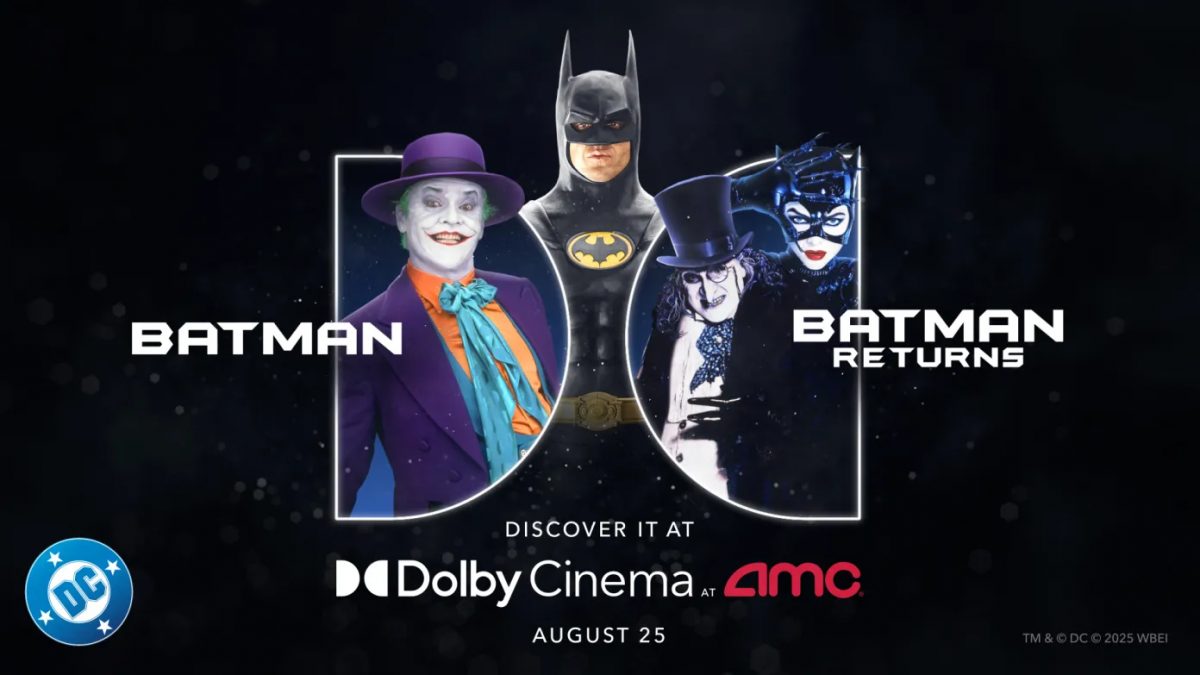
The enhanced presentation will bring to life Tim Burton’s gothic vision of Gotham City with unprecedented clarity. And it will look better than ever before. According to Warner Bros., the Dolby Vision presentation will deliver deeper blacks, sharper contrast, and more vivid colors. The Dolby Atmos will create a multi-dimensional sound experience that will especially elevate Danny Elfman’s iconic scores for both films. In a statement, Tim Burton said “I hadn’t watched these films since I made them, and seeing them again with this level of clarity, beauty, color, and sound felt really new and exciting.”
Will the two Joel Schumacher Batman films get a similar treatment? If the Burton films do well in their theatrical release, then anything is possible. Someone out there has got to want a Batman Forever and Batman & Robin one-night-only engagement. Burton’s first two Batman films helped cement the Dark Knight as a cinematic titan. And many younger fans have never seen the original films on the big screen. This presents the perfect opportunity for everyone to experience the films that started it all. After all, Michael Keaton’s Bruce Wayne, Jack Nicholson’s Joker, Michelle Pfeiffer’s Catwoman, and Danny DeVito’s Penguin remain iconic to this day for a reason.
The post Tim Burton’s BATMAN Films Return to Theaters in August appeared first on Nerdist.
It’s been ten years since Hamilton first graced the stage at the Public Theater in New York City, and nothing’s been quite the same since. From the moment Lin-Manuel Miranda delivered those opening lines, “How does a bastard, orphan, son of a whore and a Scotsman…” audiences knew this was something different. A musical about the Founding Fathers told through hip-hop? Performed by a majority-Black and brown cast? It was radical, to say the least, and immediately took its place in pop culture.

In 2016, the musical won 11 Tony Awards, including Best New Musical, and took home the Pulitzer Prize for Drama. It also earned a Grammy for Best Musical Theater Album.
But ten years later, a question arises: Has Hamilton actually changed the way we view American exceptionalism? The short answer is… yes, but not without complication. Let’s talk about it.
American exceptionalism is the belief that the United States is fundamentally distinct from and superior to other countries, due to its political structure, and commitment to democratic ideals. It positions the U.S. as a beacon of freedom, opportunity, and moral authority.

This notion stems from the idea that America was built on principles like liberty and individual rights, setting it apart from other nations. Yet, the concept is not without controversy. Critics argue that it can fuel nationalism, overlook historical injustices, and prevent honest reckoning with the country’s shortcomings. Well, I would have to agree that the critics have a point.
In today’s political landscape, discussions around exceptionalism usually hinge on which vision of America is being lifted up, and whether the country is genuinely upholding the values it claims to represent.
Insert, Hamilton. From its debut, the musical positioned itself as a reimagining of the American narrative. By telling the story of Alexander Hamilton through the lens of contemporary music and a multicultural cast, it reframed the American Revolution not as a dusty old history lesson, but as a living, breathing story of ambition and struggle.
It brought new life to this idea of American exceptionalism, as something earned. Hamilton’s rise “from the bottom” played into the age-old narrative of America as the land of opportunity. If Hamilton could write his way out of poverty, so could anyone. Really though?

This was the energizing idea in 2015 when the Obama presidency was still in full swing. Hamilton seemed to capture the hope and his “Yes, we can” mantra we had on repeat. We believed progress was possible. While Hamilton entertained and inspired us, it felt like proof that America could evolve.
So, here we are a decade later. The political climate has shifted beyond anything we could have imagined. We’ve witnessed a resurgence of white nationalism, ongoing debates over immigration, book bans, attempts to rewrite history curricula, and the continued marginalization of communities of color. The optimism that once surrounded Hamilton now lives beside skepticism about the narratives we choose to celebrate and who gets left out.
Critics have rightly pointed out that while Hamilton centers diversity in casting, it still romanticizes deeply flawed figures. Alexander Hamilton may not have owned slaves himself, but he worked within a system that upheld slavery and he didn’t challenge it. The musical, for all its innovation, largely sidesteps the foundational violence of American history, including the genocide of Indigenous peoples and the central role slavery played in building this nation.
In other words, Hamilton walks a fine line between challenging American exceptionalism and reinforcing it. It invites us to root for a Founding Father, while glossing over the parts of the founding that are trash. It gives us a version of patriotism that feels inclusive, only up to a certain point.
Still, one of the most powerful aspects of Hamilton is how it holds up a mirror to the past but also to the present. When characters rap about revolution, legacy, and power, we hear echoes of today’s headlines. Lines like “who lives, who dies, who tells your story?” hit differently in an era when history is being actively rewritten.
In 2025, the United States is once again reckoning with its identity. The presidential election’s polarization feels sharper than ever and the very idea of truth seems like it’s being held hostage. In that sense, Hamilton remains relevant. It reminds us that democracy can be messy.
I believe that progress is not linear. What is most promising for me is to see how art can intervene in the national conversation. At a time when political discourse is increasingly toxic, Hamilton offered a model for re-engaging with civic life through storytelling. It invited young people who may never had been interested in American history to ask questions about it and who belongs in the room where it happens.
So, has Hamilton changed how we view American exceptionalism? Yes, but the change is more about opening the door for deeper reflection than delivering definitive answers.
Hamilton sparked important conversations about representation and history. It’s made space for other works — like Slave Play, American Son, and Watchmen — that challenge America’s foundational myths. It’s also inspired a new generation of artists to claim their place in shaping what comes next.
I also believe we are more critical now. We recognize that representation alone is not enough, and celebrating one immigrant’s rise doesn’t automatically dismantle the systems that keep so many others out.
Maybe the most powerful thing we can do is continue asking hard questions about our history, who we celebrate, and what kind of nation we want to be. Because the truth is, Hamilton was never meant to be the final word on American identity. It was a jumping-off point to dialogue. In these uncertain times, the invitation still stands.
The post Ten Years of Hamilton: Has the Play Changed the Way We View American Exceptionalism? appeared first on Black Girl Nerds.
A Fitting Return
The Fantastic Four was the brainchild of Jack Kirby and Stan Lee. It shifted the paradigm of who could be considered a hero in comic books. By electing to put a family front and center, the space for heroes as humans opens. Not to mention its importance for comic culture, where the book becomes the beginning of the ongoing Marvel Comics Universe. This movie is about relationships. As a married person, I couldn’t help but understand these characters on such a deep level. This is what First Steps got ‘right’ that can’t be undersold.

 2025 MARVEL
Matt Shakman bridges the gap between comic purists, MCU purists, and cinephiles masterfully, but is it enough to get comic readers and MCU heads back on board? Are we back?
I don’t care who you have in your ear telling you that Marvel Studios ain’t hitting no more, even if it’s Deadpool himself. Fantastic Four: First Steps is a great comic book movie. It’s a very well-done marriage of the imaginative depth of the comics and the high-level technique of film. A lot of the ingenuity and personality that made Iron Man such a hit in 2008 is present in First Steps. The movie hits all the needed beats and showcases some of the best of both mediums.
Character
While there is no perfect movie, this comes pretty darn close to being a perfect comic book movie in the same way that James Gunn’s Superman and Shawn Levy’s Deadpool & Wolverine were close to perfect. If the production team on a comic book movie focuses on the character and allows the narrative to take shape from that character’s choices, it’s hard to miss the mark.
Fantastic Four: First Steps gives audiences exactly what Kirby and Lee envisioned based on the characters they created. More than anything, the Fantastic Four are a family of explorers and scientists. So First Steps does just that: gives us a movie that follows what happens when a group of people normalize the fantastic. When the Silver Surfer shows up to tell the Earth it’s game over, the FF suit up and go right into space. While the tension is high, Reed is explaining the plan; Ben and Johnny pretend to doze off while he’s telling them the plan! That’s the kind of character choice that makes this thing fun. It’s what makes comic books so great: the ability to get to know the characters on a deep level. It’s also what makes film so impactful, to see how their choices ripple in a fixed amount of time.
 2025 MARVEL
Bars
A part of what makes the characters so compelling is how they are written. My goodness, the bars these characters were spitting went so hard. Writing larger-than-life heroes with this high level of emotional intelligence was unheard of. The only comparison I have for some of these monologues is Gunn’s Superman; not because it set the trend, but because I saw it just the week before First Steps. There’s a solid twelve minutes of Clark and Lois going back and forth that just made the world feel so real. That gravity in writing gets split up amongst the Fantastic Four cast, but man, they go off.
To relay the ambivalence and cosmic indifference of Galactus as a universal force of nature, the Fantastic Four ask why he would want to destroy Earth. Silver Surfer simply says, “He doesn’t want. He feeds.” Like, how do you nail down the essence of a cosmic being to five words?
Who can overlook the Sue Storm banger? When the Invisible Woman speaks to the world in full view, after Galactus makes his terms and hits us with, “I’m not sacrificing my son for this planet, but I won’t sacrifice this planet for my son.” They could have played the “Ether” instrumental under the whole speech.
Another slow heater is the monologue Reed delivers to Franklin, realizing he needs to let go of the fear of whether he’ll be “normal” or not; “The more I look at you, the less I know. And the less I know, the more scared I am. So, you know what? I’m not gonna look anymore. I’m gonna let you tell me who you are.” It’s the line every son wishes their dad would say to them in earnest. I’ll be real, that one made me tear up. Writers Eric Pearson, Jeff Kaplan, Ian Springer, and Kat Wood swung for the fences on First Steps, and the whole movie reads like a love letter to Jack and Stan’s baby.
 2025 MARVEL
Setting
Shakman and the creative team really knocked the use of the multiverse out of the park. We got the FF four years into their run as a superpowered family. Their use of ‘en media res’ (starting a story midway through) worked phenomenally for Spider-Man: Homecoming and for Superman, as these IPs have sixty-plus-year publication histories. Getting to cook with this version of the Fantastic Four, from their own time, comfortable in their skin (including Ben), is what will set this apart from all the previous phases of the MCU. Moreover, it’s what makes it feel most like a comic book. A retro-futuristic aesthetic grounds the ‘828 universe’ in a way that doesn’t distract audiences from how the family navigates their adventure.
Performances
Fantastic Four: First Steps gets it right; the performances are what make this a good film, outside of the popularity of the source material. Pedro Pascal is a great actor and has been in the game longer than most people notice. As a fan of the Buffy TV show, I remember him from way back. His turn as Oberyn Martell in Game of Thrones is when I became a fan of his work. Pascal’s Reed Richards is as pitch-perfect as can be. Reed is not a stick in the mud; he’s a genius who spends every second thinking about how to solve every problem all at once. So when the other three joke with him, Pascal responds with a deadpan statement that reflects the core of who Reed Richards is, a know-it-all.
Joseph Quinn has been on the rise in the US after Stranger Things and Gladiator 2, but his Johnny Storm is also pitch-perfect. A little less player and a lot more mission-focused, but always a pain in Ben’s neck. Most iterations of Johnny are a playboy idiot with a rockstar lifestyle. First Steps evolves Johnny’s character to be a sharper intellect and a better family member. We’re even treated to a pivotal plot point for the film and a moment of self-sacrifice akin to that moment in the Annihilation comic (issue #587). Again, pitch perfect.
 2025 MARVEL
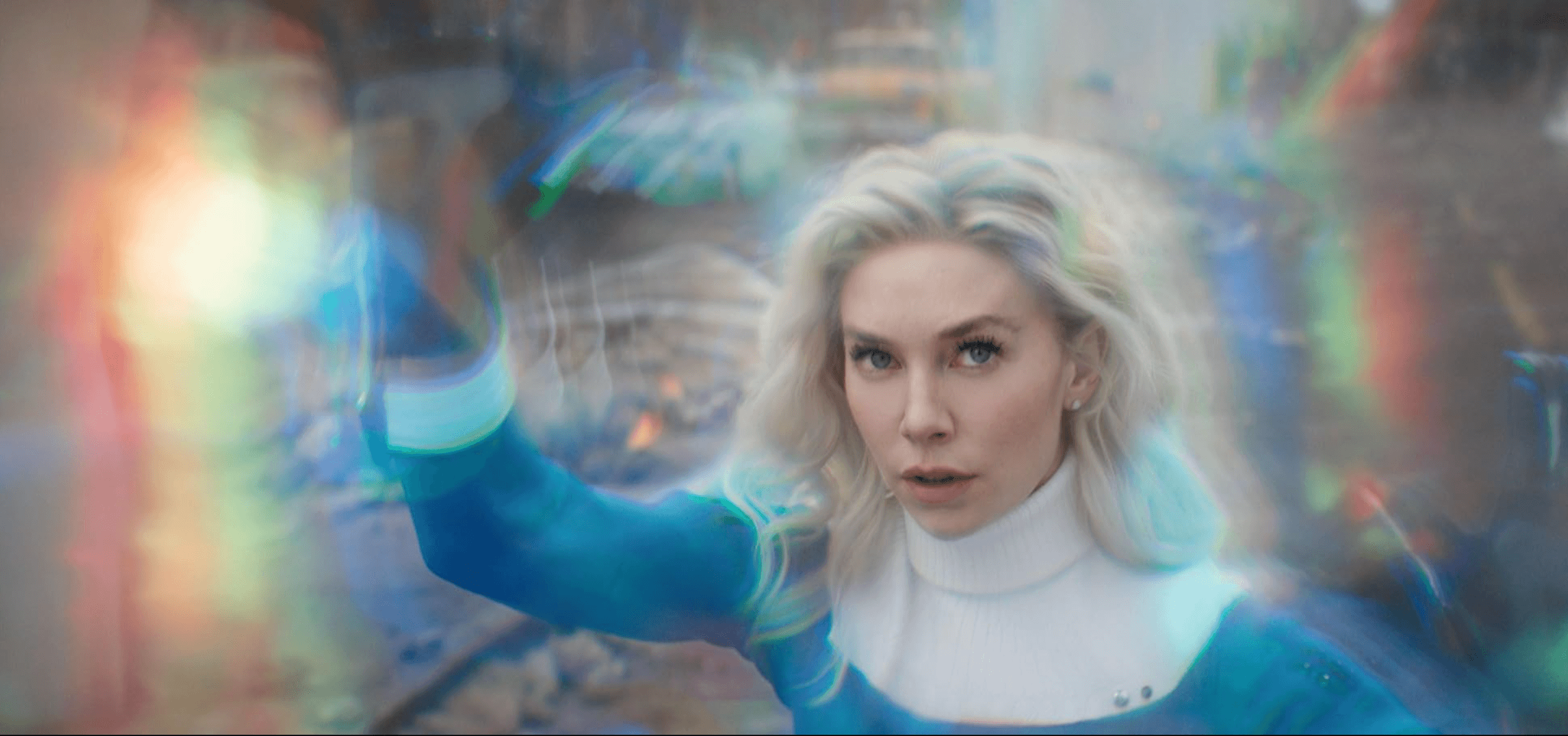
Vanessa Kirby’s Susan Storm had very little competition to begin with but is the gold standard for how to bring that character to life off the page. Although this version of Sue has never been present in the previous films, the ferocious capability of the Invisible Woman is well-known to comic readers. She took on the Avengers single-handedly and handed them their asses soundly. What Kirby brings to Sue is so much more than giving cunty face, but a very poetic strength that can’t be seen, only felt. Going so far as to read the issues exploring Sue’s dark alter ego, Malice. Bringing this badass Susan Storm to the 616 universe is a gift we weren’t expecting.
Ebon Moss-Bacharach has the difficult task of conveying the ‘fight through the sadness’ ethos that lies at the core of Benjamin Grimm’s character. Bacharach’s gruff outside but warm interior is what makes his portrayal of Richie on The Bear so entertaining, and he channels that in First Steps by giving The Thing more security than Richie might ever have. Depending on motion capture and CGI to get the visuals, the things that make Ben human rely on Bacharach to convey with his voice and small tics, and gestures. Pitch. Freaking. Perfect.
Rounding out the cast, Paul Walter Hauser had no reason to make Mole Man so damn compelling and funny. That man steals every scene he’s in, no matter what. Julia Garner is amazing as the Silver Surfer. She picks up where Doug Jones and Laurence Fishburne’s joint performance left off and doesn’t miss a beat. Stoic, conflicted, and badass. Big ups to Sarah Niles as Lynn Nichols, the Future Foundation CEO, FF’s handler, and the sole Black member of this cast.
 2025 MARVEL
Impact
I would be remiss not to speak about the way I saw myself and my wife reflected in the peaks and valleys of Sue and Reed’s relationship. Some moments felt lifted from our daily life and placed on film. Mind you, following a couple happens very often in movies, but this is a comic book movie – those familial attachments are usually secondary. When Sue comes out of the bathroom and finds in mere seconds what Reed was searching for twelve minutes to find, I can’t help but feel seen. The peaks and valleys of their interactions are the fabric of any tried-and-true partnership. They are not with each other because they agree on everything, but because they are both invested in fixing everything. No matter the time, no matter the cost. That is the core of my marriage with my partner, not that anything is perfect, but that there is always work to do to get better – and we aren’t afraid of that work. Reed’s monologue to Franklin is what stuck with me. When he admits that the more he learns about fatherhood, the less he realizes he knows. A realization I wish my father had made. But this is what masterful character writing gets you: a family that faces all of its internal challenges with the same grit and transparency as its external ones. This is the kind of exploration that elevates the genre. It hit.
Full Circle
Fantastic Four: First Steps is a good step in the right direction for the MCU. Tonally, it feels like a return to form, focusing on the characters rather than the hullabaloo of studio politics. Marvel’s ‘First Family’ is bringing that love and determination into the 616, come hell or high water. Jack and Stan would be so proud of this film. [Excelsior!]
Want to get Black Nerd Problems updates sent directly to you? Sign up here! Follow us on BlueSky ,Twitter, Facebook, YouTube, Twitch, and Instagram!
The post Are We Back?: ‘Fantastic Four: First Steps’ Review appeared first on Black Nerd Problems.