
deerstalker
https://www.blackenterprise.com/5-holiday-home-insurance-tips-stop-package-theft/
The increasing reliance on e-commerce, particularly during the peak holiday season, has led to a parallel rise in package theft, a persistent property crime impacting millions of homeowners and renters annually. The moment a delivery is marked “completed,” that parcel sitting on your doorstep becomes a vulnerable asset.
The scope of this issue is significant: Current data indicates that up to a quarter of Americans have been victimized by package theft at some point, with billions of dollars’ worth of merchandise stolen each year, placing stress on retailers, law enforcement, and, ultimately, the consumer. The holiday period, defined by the high volume of deliveries between major shopping events like Black Friday and the new year, presents an elevated risk window for thieves to steal packages off your porch.
While standard homeowners insurance policies typically cover theft, the financial reality of high deductibles often means that filing a claim for a stolen package is not financially prudent or worthwhile. Cheap Insurance recommends that prevention is often the most practical strategy.
Home Insurance: A Necessary, But Limited, Safety Net
While the focus of this guide is on prevention, the most cost-effective and immediate strategy, it is important to understand the role of your homeowners’ insurance policy. This coverage is your financial backstop against a variety of perils, and yes, it does cover package theft.
What Your Policy Covers
- Theft Coverage: Standard homeowners and renters insurance includes coverage for personal property theft, which extends to packages stolen from your porch. This coverage is not limited to your dwelling and typically applies to items stolen anywhere in the world, including your front steps.
- The Limit: The total amount your insurance company will pay out is subject to your policy’s personal property coverage limit, which is usually a percentage of your dwelling coverage (50%-70%).
- Proof of Loss: To file a claim, you will need to provide proof of loss, which includes a police report documenting the theft, as well as receipts, bank statements, or tracking information that proves the item was purchased and delivered to your address. This is where your smart security camera footage becomes invaluable.
1. Invest in Smart Security Cameras
This is a strong line of defense. A visible video doorbell or an exterior security camera system isn’t just a recording device; it’s a powerful deterrent. Thieves are in the business of easy, quick grabs. The sight of a lens, often accompanied by a blinking light or a clearly marked yard sign, tells them this house is not an easy target. Crucially, many home insurance providers offer premium discounts for installing these systems, recognizing their value in preventing claims.
Why it Works:
- Deterrence is Key: Many thieves will move on simply because they don’t want their face (or license plate) captured in 4K resolution.
- Real-Time Alerts: Smart systems send an immediate notification to your phone the moment motion is detected, often categorizing it as a “Person” or “Package.” This allows you to spring into action, even if you’re miles away.
- Two-Way Talk: Imagine getting an alert, opening your app, and loudly announcing, “I see you. That package has been digitally marked, and the police are on the way.” The startled reaction is usually immediate and priceless.
2. Utilize Secure Delivery Solutions
The truth is, even the best camera can only record a theft. To truly avoid the holiday claim, you need to eliminate the opportunity for the thief altogether. Your front porch is not a bank vault, so don’t treat it like one, especially if you want to avoid filing a potentially complicated home insurance claim for stolen packages.
Smart and Secure Options:
- Package Lockers & Drop-Off Points: Services like Amazon Lockers, FedEx Office, or UPS Stores offer a secure, off-site location for your parcels. This is one of the most secure methods, as the package never comes into contact with your home’s exterior. For high-value items, this is nonnegotiable.
- Secure Delivery Boxes: These are attractive, sturdy, and often digitally-enabled boxes that sit on your porch. They typically feature a one-way opening or a keypad. The delivery driver enters a temporary, carrier-specific code, deposits the package, and the box locks securely.
- Smart Garage/In-Home Delivery: Services like Amazon Key allow a verified delivery driver to briefly access your garage or even your front door (via a smart lock) to place the package inside your home’s boundary. The entire process is monitored by a camera and automatically relocked, offering maximum protection from the elements and the pirates.
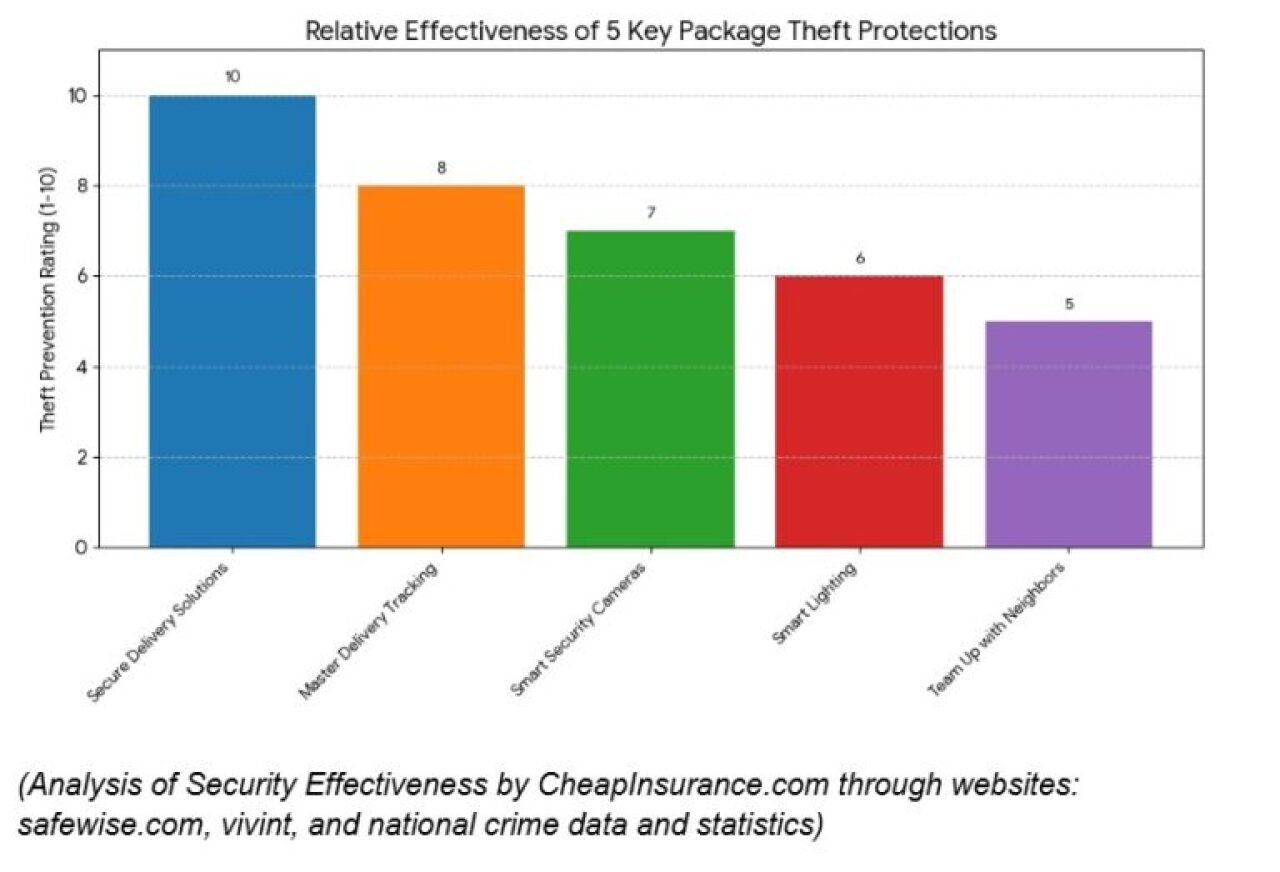
The chart below shows data analysis of security effectiveness by CheapInsurance.com, utilizing SafeWise, Vivint, and national crime data and statistics.
3. Leverage Smart Lighting
Criminals prefer to operate under the cover of darkness. A well-lit home can make them feel exposed and draw unwanted attention to their activities. This is where smart exterior lighting comes in, acting as a powerful, low-tech security measure integrated with your high-tech system, which can be an important factor in your home insurance risk assessment.
Strategic Lighting for Security:
- Motion-Activated Floodlights: The unexpected, sudden blinding light from a motion sensor is a classic, effective shock tactic. Placing them strategically over the porch and driveway ensures anyone approaching is instantly spotlighted.
- Smart Bulb Automation: Use smart bulbs that can be programmed via your home security hub or mobile app. You can set them to turn on or off on a schedule, or even use a “randomized” setting while you’re away to mimic human activity inside the home. This creates a powerful illusion of a busy, occupied residence.
- Integration with Cameras: Many smart camera systems can trigger associated smart lights when motion is detected, effectively illuminating the very area the camera needs to record. This ensures crystal-clear, well-lit footage, which is critical for identifying a thief and aiding law enforcement.
Think of this as a layered, integrated security ecosystem where your lighting, cameras, and locks all communicate to create a cohesive defense, making the environment hostile to opportunistic crime and potentially leading to discounts on your home insurance rate.
4. Master Delivery Tracking
Knowledge is power, and in the world of package delivery, real-time data is your best friend. Porch pirates operate on a simple principle: Packages are easy to grab when they’re left unattended for long periods. Reducing the time your package is on the porch is a crucial factor in theft prevention.
Be a Tracking Ninja:
- Carrier Alerts: Sign up for email or text alerts from all major carriers (USPS Informed Delivery, UPS My Choice, FedEx Delivery Manager). These services give you detailed tracking, often down to a four-hour delivery window.
- The Power of the App: Most major retailers and carriers have mobile apps that provide minute-by-minute updates. If you see the “Delivered” notification pop up, it’s your immediate cue to retrieve it or message a trusted neighbor.
- Require a Signature: For very expensive or critical items, always select the “Signature Required” option. This is an old-school, analog protection that physically prevents the carrier from leaving the package without a human hand to receive it.
Actionable Insight: Use the tracking information to coordinate with your schedule. If you know a package is arriving at 2:00 p.m. and you’ll be home at 5:30 p.m., you’ve created a 3.5-hour window for a thief. Instead, use the carrier’s app to redirect the delivery to a later day or a secure pickup point.
5. Team Up with Your Neighbors
Before there were smart cameras and AI-powered security systems, there were neighbors. The original, and still one of the most effective, security networks is your local community. In an age of digital connection, you can amplify this human connection into a powerful deterrent.
Leveraging the Community Ecosystem:
- The “Package Pal” System: Get to know a trusted, at-home neighbor. Offer to retrieve their packages when they are away, and ask them to do the same for you. A simple text message, “Hey, just grabbed your Amazon box!”, can save a holiday from disaster.
- Nextdoor/Local Group Chats: Use neighborhood apps to share information. If a package theft is reported two blocks over, you and your neighbor can be extra vigilant for the rest of the day. This creates a real-time, responsive community defense grid.
- Visible Deterrents: Encourage neighbors to install visible security signs or window decals to deter potential porch pirates. The more the neighborhood looks like a well-monitored zone, the less appealing it becomes to casual thieves who prefer soft targets.
The joy of the holidays should never be overshadowed by the anxiety of package theft. By implementing these five-layered strategies, from the high-tech digital sentinel of a smart camera to the simple, human network of a trusted neighbor, you are effectively fortifying your home against opportunistic crime.
This year, don’t let a porch pirate file a claim on your holiday cheer. Stay smart, stay connected, and keep those well-earned gifts safe and secure. Take back your porch, and enjoy the season, knowing your five key protections are standing guard.
This story was produced by CheapInsurance.com and reviewed and distributed by Stacker.
RELATED CONTENT: 10 Black Movies That Bring Out The Christmas Cheer
The increasing reliance on e-commerce, particularly during the peak holiday season, has led to a parallel rise in package theft, a persistent property crime impacting millions of homeowners and renters annually. The moment a delivery is marked “completed,” that parcel sitting on your doorstep becomes a vulnerable asset.
The scope of this issue is significant: Current data indicates that up to a quarter of Americans have been victimized by package theft at some point, with billions of dollars’ worth of merchandise stolen each year, placing stress on retailers, law enforcement, and, ultimately, the consumer. The holiday period, defined by the high volume of deliveries between major shopping events like Black Friday and the new year, presents an elevated risk window for thieves to steal packages off your porch.
While standard homeowners insurance policies typically cover theft, the financial reality of high deductibles often means that filing a claim for a stolen package is not financially prudent or worthwhile. Cheap Insurance recommends that prevention is often the most practical strategy.
Home Insurance: A Necessary, But Limited, Safety Net
While the focus of this guide is on prevention, the most cost-effective and immediate strategy, it is important to understand the role of your homeowners’ insurance policy. This coverage is your financial backstop against a variety of perils, and yes, it does cover package theft.
What Your Policy Covers
- Theft Coverage: Standard homeowners and renters insurance includes coverage for personal property theft, which extends to packages stolen from your porch. This coverage is not limited to your dwelling and typically applies to items stolen anywhere in the world, including your front steps.
- The Limit: The total amount your insurance company will pay out is subject to your policy’s personal property coverage limit, which is usually a percentage of your dwelling coverage (50%-70%).
- Proof of Loss: To file a claim, you will need to provide proof of loss, which includes a police report documenting the theft, as well as receipts, bank statements, or tracking information that proves the item was purchased and delivered to your address. This is where your smart security camera footage becomes invaluable.
1. Invest in Smart Security Cameras
This is a strong line of defense. A visible video doorbell or an exterior security camera system isn’t just a recording device; it’s a powerful deterrent. Thieves are in the business of easy, quick grabs. The sight of a lens, often accompanied by a blinking light or a clearly marked yard sign, tells them this house is not an easy target. Crucially, many home insurance providers offer premium discounts for installing these systems, recognizing their value in preventing claims.
Why it Works:
- Deterrence is Key: Many thieves will move on simply because they don’t want their face (or license plate) captured in 4K resolution.
- Real-Time Alerts: Smart systems send an immediate notification to your phone the moment motion is detected, often categorizing it as a “Person” or “Package.” This allows you to spring into action, even if you’re miles away.
- Two-Way Talk: Imagine getting an alert, opening your app, and loudly announcing, “I see you. That package has been digitally marked, and the police are on the way.” The startled reaction is usually immediate and priceless.
2. Utilize Secure Delivery Solutions
The truth is, even the best camera can only record a theft. To truly avoid the holiday claim, you need to eliminate the opportunity for the thief altogether. Your front porch is not a bank vault, so don’t treat it like one, especially if you want to avoid filing a potentially complicated home insurance claim for stolen packages.
Smart and Secure Options:
- Package Lockers & Drop-Off Points: Services like Amazon Lockers, FedEx Office, or UPS Stores offer a secure, off-site location for your parcels. This is one of the most secure methods, as the package never comes into contact with your home’s exterior. For high-value items, this is nonnegotiable.
- Secure Delivery Boxes: These are attractive, sturdy, and often digitally-enabled boxes that sit on your porch. They typically feature a one-way opening or a keypad. The delivery driver enters a temporary, carrier-specific code, deposits the package, and the box locks securely.
- Smart Garage/In-Home Delivery: Services like Amazon Key allow a verified delivery driver to briefly access your garage or even your front door (via a smart lock) to place the package inside your home’s boundary. The entire process is monitored by a camera and automatically relocked, offering maximum protection from the elements and the pirates.
The chart below shows data analysis of security effectiveness by CheapInsurance.com, utilizing SafeWise, Vivint, and national crime data and statistics.
3. Leverage Smart Lighting
Criminals prefer to operate under the cover of darkness. A well-lit home can make them feel exposed and draw unwanted attention to their activities. This is where smart exterior lighting comes in, acting as a powerful, low-tech security measure integrated with your high-tech system, which can be an important factor in your home insurance risk assessment.
Strategic Lighting for Security:
- Motion-Activated Floodlights: The unexpected, sudden blinding light from a motion sensor is a classic, effective shock tactic. Placing them strategically over the porch and driveway ensures anyone approaching is instantly spotlighted.
- Smart Bulb Automation: Use smart bulbs that can be programmed via your home security hub or mobile app. You can set them to turn on or off on a schedule, or even use a “randomized” setting while you’re away to mimic human activity inside the home. This creates a powerful illusion of a busy, occupied residence.
- Integration with Cameras: Many smart camera systems can trigger associated smart lights when motion is detected, effectively illuminating the very area the camera needs to record. This ensures crystal-clear, well-lit footage, which is critical for identifying a thief and aiding law enforcement.
Think of this as a layered, integrated security ecosystem where your lighting, cameras, and locks all communicate to create a cohesive defense, making the environment hostile to opportunistic crime and potentially leading to discounts on your home insurance rate.
4. Master Delivery Tracking
Knowledge is power, and in the world of package delivery, real-time data is your best friend. Porch pirates operate on a simple principle: Packages are easy to grab when they’re left unattended for long periods. Reducing the time your package is on the porch is a crucial factor in theft prevention.
Be a Tracking Ninja:
- Carrier Alerts: Sign up for email or text alerts from all major carriers (USPS Informed Delivery, UPS My Choice, FedEx Delivery Manager). These services give you detailed tracking, often down to a four-hour delivery window.
- The Power of the App: Most major retailers and carriers have mobile apps that provide minute-by-minute updates. If you see the “Delivered” notification pop up, it’s your immediate cue to retrieve it or message a trusted neighbor.
- Require a Signature: For very expensive or critical items, always select the “Signature Required” option. This is an old-school, analog protection that physically prevents the carrier from leaving the package without a human hand to receive it.
Actionable Insight: Use the tracking information to coordinate with your schedule. If you know a package is arriving at 2:00 p.m. and you’ll be home at 5:30 p.m., you’ve created a 3.5-hour window for a thief. Instead, use the carrier’s app to redirect the delivery to a later day or a secure pickup point.
5. Team Up with Your Neighbors
Before there were smart cameras and AI-powered security systems, there were neighbors. The original, and still one of the most effective, security networks is your local community. In an age of digital connection, you can amplify this human connection into a powerful deterrent.
Leveraging the Community Ecosystem:
- The “Package Pal” System: Get to know a trusted, at-home neighbor. Offer to retrieve their packages when they are away, and ask them to do the same for you. A simple text message, “Hey, just grabbed your Amazon box!”, can save a holiday from disaster.
- Nextdoor/Local Group Chats: Use neighborhood apps to share information. If a package theft is reported two blocks over, you and your neighbor can be extra vigilant for the rest of the day. This creates a real-time, responsive community defense grid.
- Visible Deterrents: Encourage neighbors to install visible security signs or window decals to deter potential porch pirates. The more the neighborhood looks like a well-monitored zone, the less appealing it becomes to casual thieves who prefer soft targets.
The joy of the holidays should never be overshadowed by the anxiety of package theft. By implementing these five-layered strategies, from the high-tech digital sentinel of a smart camera to the simple, human network of a trusted neighbor, you are effectively fortifying your home against opportunistic crime.
This year, don’t let a porch pirate file a claim on your holiday cheer. Stay smart, stay connected, and keep those well-earned gifts safe and secure. Take back your porch, and enjoy the season, knowing your five key protections are standing guard.
This story was produced by CheapInsurance.com and reviewed and distributed by Stacker.
RELATED CONTENT: 10 Black Movies That Bring Out The Christmas Cheer

Anyone who has been keeping up with the recent news is likely aware of the situation surrounding Pete Hegseth. The Secretary of War for the United States is currently under intense public scrutiny for his actions dating back to September.
In the first week of September, under the directives of Donald Trump and Pete Hegseth, several attacks were launched on vessels in the Caribbean Sea. While there wasn’t much sensational coverage of the incident at the time, it has since gained significant attention due to its controversial nature. It turns out that during one of these raids conducted by Hegseth’s forces, they discovered several individuals on boats whom they suspected of drug trafficking. In accordance with the law, one of these boats was attacked, leading to multiple fatalities. However, after the initial attack, two individuals were still alive, prompting the forces to strike the boat a second time. This second strike, unlike the first, was executed unlawfully. This has become a topic of criticism because if Hegseth was responsible for the order, he may have committed a war crime and should face legal repercussions.

Sound the alarms—the internet’s concerned about a new entitled man online.
It started when Justin (@justinbarberfit), a content creator on TikTok, took to the platform to complain about women not talking to him in a video that’s gotten over 816,000 views.