
deerstalker
https://www.themarysue.com/woman-crawfish-pet/

Who among us hasn’t felt a pang of remorse over the plight of livestock? It’s only human to feel sad to know that cute calf frolicking in the field will one day be the juicy ribeye sizzling on the grill.
For many of us, it’s easier to feel sympathy for our fellow mammals. Be it a pig, lamb, deer, or rabbit, warm-blooded creatures just tend to solicit more emotion.
Who among us hasn’t felt a pang of remorse over the plight of livestock? It’s only human to feel sad to know that cute calf frolicking in the field will one day be the juicy ribeye sizzling on the grill.
For many of us, it’s easier to feel sympathy for our fellow mammals. Be it a pig, lamb, deer, or rabbit, warm-blooded creatures just tend to solicit more emotion.
Superman, Batman, Wonder Woman, DC Comics has some of the world’s greatest superheroes. But we feel comfortable saying even more than good guys, DC has the greatest villains in all of comics. Many of which have been household names for generations. Although Batman has the lion’s share of great adversaries, it’s not just the Dark Knight who can boast about having an incredible rogues’ gallery. We narrowed down the top ten DC Comics villains of all time, based not only on their comic book careers, but in outside comics media as well. We’ve decided to keep it to straight-up villains and not characters who have been rehabilitated and have long careers as anti-heroes, like Catwoman and Harley Quinn. This list is reserved for the worst of the worst.
10. Ares
First appearance: Wonder Woman #1 (1942) Created by William Moulton Marston and Harry G. Peter

Wonder Woman famously doesn’t have the deep bench of classic villains that her trinity brothers Superman and Batman do. Most readers cite the Cheetah as Diana’s primary adversary, thanks to many animated shows. But Diana’s true greatest villain is the Ares, the Greek God of War. Simply because he’s the living embodiment of conflict and hatred, and everything Wonder Woman stands against. In many ways, as an Olympian god, Ares is more of the representation of an idea than a person.
Having said that, an idea can be as destructive as an individual, which is what makes Ares so dangerous. In both the modern comics and the 2017 Wonder Woman movie, Diana’s first and greatest villain is the War God, who has used his influence to make mankind more destructive over the years. But what’s most insidious about him is that he doesn’t make humans bloodthirsty, he just brings out what’s already there. We know in our own real world that war and violence are the worst part of humanity, and Ares is our worst tendency as a species given life. This elevates him from the rest of the Amazing Amazon’s recurring foes.
9. The Anti-Monitor (Mobius)
First appearance: Crisis on Infinite Earths #2 (1985) Created by Marv Wolfman, George Perez, and Jerry Ordway

He may have a silly name, but no villain has come closer to destroying the DC Universe than the Anti-Monitor. A being as old as the universe itself, the Anti-Monitor is the Anti-Matter Universe’s counterpart to the benevolent Monitor, who watches over the Positive-Matter Multiverse. Created by Marv Wolfman and George Perez, the Anti-Monitor, whose true name was later revealed as Mobius, was the central villain of the epic Crisis on Infinite Earths crossover. In that year-long story, he did a lot of damage.
Mobius’ quest to spread his Anti-Matter Universe to obliterate all other universes resulted in the deaths of the Flash (Barry Allen) and Supergirl, not to mention countless other DC characters. After his defeat in Crisis, the Anti-Monitor all but disappeared for decades. However, he reemerged in the 21st century in major event books, such as The Sinestro Corps War, Blackest Night, and Forever Evil. Yes, his appearances are far fewer than most others on this list. But considering he killed trillions and reshaped the DC Universe itself, he’s earned his spot among DC’s Biggest Bads.
8. Mister Freeze (Victor Fries)
First appearance: Batman #121 (1959) Created by Sheldon Moldoff and Bob Kane

Mister Freeze first debuted in an issue of Batman in 1959, named Mister Zero. He was just an unnamed scientist who needed an ice-cold containment suit after a mishap in creating a freeze gun. And there wasn’t much more to him than that. After one appearance, he more or less vanished for years. But the 1966 Batman TV series revived the character as Mister Freeze, giving the villain a second life. He was still a one-note villain with no real character or motivation beyond robbing banks. However, that all changed thanks to one episode of Batman: The Animated Series in 1992.
In the B:TAS episode “Heart of Ice,” writer Paul Dini gave Mister Freeze a tragic backstory. As Dr. Victor Fries, he became obsessed with using cryogenic technology to save the life of his dying wife, Nora. When a greedy CEO destroys her chances at survival, and causes Fries’ accident which confines him to below-zero temperatures, he becomes a cold and emotionless man in more than just name. Well, emotionless except for being hellbent on revenge. Much like Spock in Star Trek, this supposedly emotionless character conveys more emotion in his monotone delivery than by being flagrantly emotional. Eventually, DC adopted his animated backstory to the comics canon. Ultimately, what makes Freeze so great is that he’s completely sympathetic, yet no less sinister because of it.
7. The Reverse-Flash/Professor Zoom (Eobard Thawne)
First appearance: The Flash #139 (1963) Created by John Broome and Carmine Infantino

Some of the greatest pop culture villains are the ones whose entire motivations center on obsession, jealousy, and finally, revenge. Eobard Thawne, the Reverse-Flash, Flash’s greatest foe, is one of the best examples of this kind of adversary. He started out in the Silver Age as just another “opposite coin of the hero” bad guy, in terms of both appearance and powers. He was just a speedster who used his powers for evil. But over the years, writers made his motivations for hating the Flash and his legacy richer. Eobard Thawne grew up centuries in the future, idolizing the Flash, Barry Allen. He even recreated the experiment that gave Barry his powers. He also went as far as to get cosmetic surgery to look like his idol. But when he found out he was destined to travel back in time and become the Flash’s greatest foe, he snapped.
Thawne has used his immense speed powers ever since to inflict as much pain as possible on Barry Allen and his legacy. First, by killing his wife Iris in cold blood, then by impersonating him when the world thought he was dead. Eventually came the worst crime, going back in time to Barry’s childhood and murdering his mother. Despite Flash breaking his moral code and murdering him in retaliation, Thawne continues to find a way back to life. He continues to make life miserable for the man he wishes he was. All of this makes him more than just “the bad Flash.” He’s only had one real live-action incarnation, on the CW Flash TV series. But even there, he stole the show.
6. Sinestro
First appearance: Green Lantern #7 (1961) Created by John Broome and Gil Kane

When he was first created in the Silver Age of comics, Thaal Sinestro of the planet Korugar was a standard “opposite” villain for Green Lantern. This is similar to Bizarro and Superman, or what Reverse-Flash was to the Flash. Since all Green Lanterns had a weakness against the color yellow, Sinestro was the villain with a yellow-powered ring. The yellow energy was fueled by the emotion of fear. It was pretty basic, and his characterization was flat in those early years. But eventually, Sinestro became far more nuanced and interesting.
In subsequent years, Sinestro has become the Anakin Skywalker of the DC Universe. Once the greatest of the Green Lantern Corps, his hubris and fascistic tendencies caused him to fall to the dark side. This made him a far more complex villain than before. Some of his viewpoints about maintaining order in the cosmos actually do make sense, making him somewhat sympathetic. One of DC Comics’ most epic crossovers, The Sinestro Corps War, put Sinestro front and center, leading his own corps. These days, he’s a reluctant hero again. But we think it’s safe to say that Sinestro’s legacy as a villain will always overshadow any temporary “good guy” phases.
5. Deathstroke (Slade Wilson)
First Appearance: New Teen Titans #2 (1980) Created by Marv Wolfman and George Perez

Deathstroke the Terminator, as he was originally known, first debuted in New Teen Titans #2 back in 1980. Created by Marv Wolfman and George Perez, he became the Titans’ primary antagonist, later fighting characters like Batman. He was a sort of inverse Captain America, an American soldier given superior strength and agility by the U.S. government. But without Steve Rogers’ moral compass, he became an enhanced mercenary who enriched himself instead of serving a higher calling. His Achilles’ Heel is his twisted sense of honor, which can cause him to do heinous things.
When his son Grant dies fighting the Titans, he takes over his contract on the team, going as far as to manipulate and seduce the teenage sociopath Terra to infiltrate the group. In the ‘90s, Deathstroke received his own ongoing series, which portrayed him as more of an anti-hero. But in more recent years, and after various DC reboots, he’s once again in the category of “complex villain.” His personal vendetta against the Titans, plus his position as a notable adversary for both Batman and Green Arrow, has made Deathstroke one of the all-time greats. Besides, without Slade Wilson, there would be no Wade Wilson, a.k.a. Deadpool, who began as a Deathstroke parody character.
4. Ra’s al Ghul
First Appearance: Batman #244 (1972) Created by Dennis O’Neil, Neal Adams, and Julius Schwartz
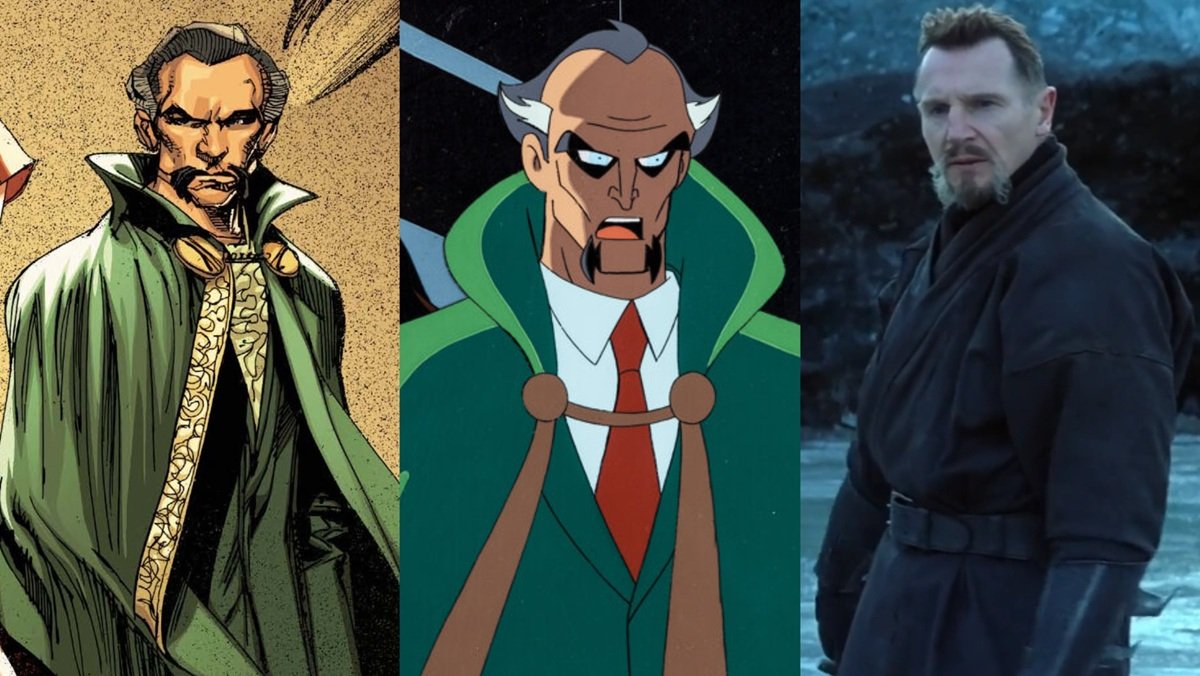
Created by writer Denny O’Neil and artist Neal Adams in the early ’70s, the name Ra’s al Ghul translates to “the Demon’s Head.” He was designed to give Batman an enemy that was more than just another colorful Gotham City mobster. Ra’s was a combination of Sherlock Holmes’ Moriarty and a world-dominating Bond villain. A near-immortal, thanks to his dips into his Lazarus pit, Ra’s had seen centuries of human warfare and destruction of the planet, to the point where he realized Earth needed saving from itself. With himself as absolute ruler, of course.
What makes Ra’s a compelling villain is that he not only respects his adversary Batman, he wants to make him part of his family. In fact, they’ve been temporary allies as often as enemies. Especially as Bruce Wayne maintained a romantic involvement with Ra’s daughter Talia, and has a son with her. Ra’s al Ghul appeared in Batman: The Animated Series played to perfection by the late, great David Warner. Later, Liam Neeson played him in Batman Begins. Both portrayals elevated Ra’s al Ghul’s profile in outside comics media, making him even more iconic. Smart, cunning, and often suave, Ra’s is the kind of bad guy you sometimes can’t help but root for. (Editor’s Note: We will die on the hill that his name is pronounced “Raysh,” not “Raz.” Christopher Nolan’s lowkey biggest crime.)
3. Lex Luthor
First Appearance: Action Comics #23 (1940) Created by Jerry Siegel and Joe Shuster
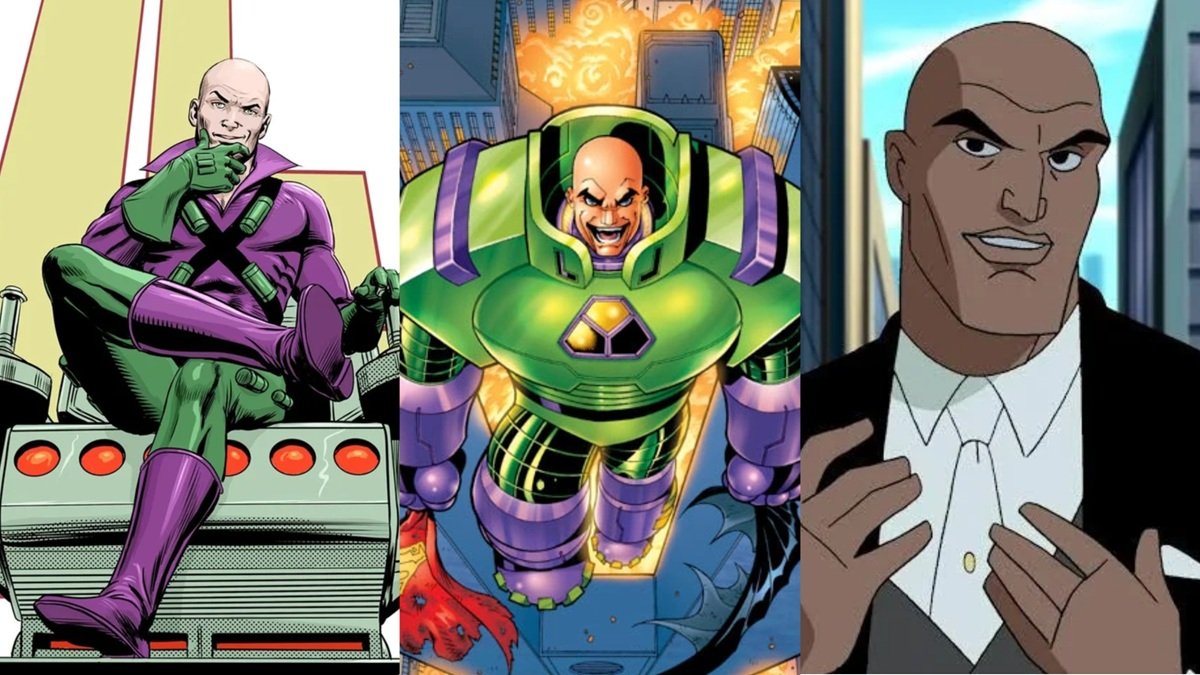
In Superman’s earliest days, he fought one mad scientist after another. So why did Lex Luthor, of all those by-the-numbers evil geniuses with death rays, rise to the top, and become so iconic? Well, for starters, he has a great alliterative name. You can’t count out the power of a catchy name. In those first few decades, maybe that was enough. But even in cartoons like Super Friends and in Gene Hackman’s cinematic portrayal, Lex was a standard mustache twirling cliche. However, what makes Luthor such an all-timer villain is how writers over the last few decades, both in comics and other media, have added so many layers to him as a character.
First, they gave him a shared history with Superboy in Smallville back in the Silver Age, as former best friends who fell out. That always makes for a compelling hero/villain dynamic. Then, in the ‘80s, he was reinvented as someone who used his genius intellect to become a billionaire CEO. Despite his intelligence, his hatred of Superman came from an inability to understand someone with power who doesn’t use it to enrich themselves. Later incarnations, like Smallville and the comic Secret Origin, found a way to meld these two disparate versions of Lex Luthor into one superior iteration. Lex has become the perfect embodiment of the dark side of American ambition. The darkness of pure ego and ambition. And because of this, he’ll always be relevant.
2. The Joker
First Appearance: Batman #1 (1940) Created by Bill Finger, Jerry Robinson, and Bob Kane

Although he’s the number two entry on this list, the Joker is easily the most recognizable DC villain of them all, especially when it comes to mainstream audiences. Two different actors have won Oscars for playing him even. And while he may be overexposed, there’s no denying the power of the Clown Prince of Crime. Created by Bill Finger, Jerry Robinson, and supposedly Bob Kane, the Joker debuted in Batman #1 in 1940. An evil clown before evil clowns were a thing, Joker was the perfect antithesis of Batman, a hero who dresses like a villain. The so-called Harlequin of Hate was an instant hits with readers, and became Batman’s primary enemy.
The Joker is so great for several reasons. First, he represents pure chaos, truly unhinged evil. He’s so scary because he is a force of nature with no true motivations beyond malevolence. There’s no reasoning or appealing to his good side. Second, he’s malleable. He can be the previously mentioned psychotic killer, or he can be a more benign prankster villain who just wants Batman’s attention. He can go totally without a backstory, as most DC Comics and the Dark Knight gave us, or he can have a very detailed one, like The Killing Joke, Batman ’89, or Todd Phillips’ Joker. And yet, they’re all still the Joker at their core.

Another reason for his iconic status is that he’s a perfect foil for Batman, a hero who refuses to kill. Because the Joker keeps committing acts so heinous, like crippling Batgirl and murdering Robin, it tests the limits of his vow to never take a life. He becomes the perfect template for writers to tell the most compelling kinds of Batman stories. And that is all just part of what makes him eternal. Of all the DC villains, the Joker is the one we’re still going to be reading about and seeing on our screens a hundred years from now.
1. Darkseid
First Appearance: Superman’s Pal Jimmy Olsen #134 (1970) Created by Jack Kirby

Jack Kirby created Marvel’s greatest villain, Doctor Doom. But a decade later, he also created DC’s greatest villain in the form of Darkseid. The Lord of Apokolips is essentially the God of Evil. He’s a being of oppressive malice who wants nothing more than to sap free will out of the universe. He first appeared as the main adversary in Kirby’s Fourth World line of comics, starting in 1970. At first, he was limited to those titles, using his Omega beams to destroy in series like New Gods. But eventually, he branched out, becoming the DC Universe’s biggest threat. First, by starting the Secret Society of Super-Villains, then by fighting the Justice League and Justice Society together.
What makes Darkseid the best is that he’s a villain for the DC Universe overall, as well as a personal adversary to some of the company’s biggest heroes, like Superman, Wonder Woman, and the Justice League. He killed Batman in Final Crisis, murdered half of Wonder Woman’s sister Amazons in her comic, and plagued the 30th century in the Legion of Super-Heroes’ Great Darkness Saga. He even resurrected Marvel’s Dark Phoenix to destroy the Teen Titans and the X-Men in one of the best DC/Marvel crossovers of all time.

In outside comics media, he was the “Big Bad” of the iconic Super Powers action figure line, and two seasons of the Saturday morning Super Friends cartoon. In the ‘90s, he brainwashed Superman into attacking the Earth as his puppet in the animated DC universe. He has appeared in a metric ton of DC animated films. We’ve only just barely glimpsed Darkseid in a live-action film, as a cameo in Zack Snyder’s Justice League. But even without any major cinematic exposure, the deadly New God is easily DC’s most notorious villain of all time. And that’s why he sits proudly atop the #1 spot.
The post The 10 Greatest DC Comics Villains, Ranked appeared first on Nerdist.